Can Red Meat Keep Up with the Chicken Run?

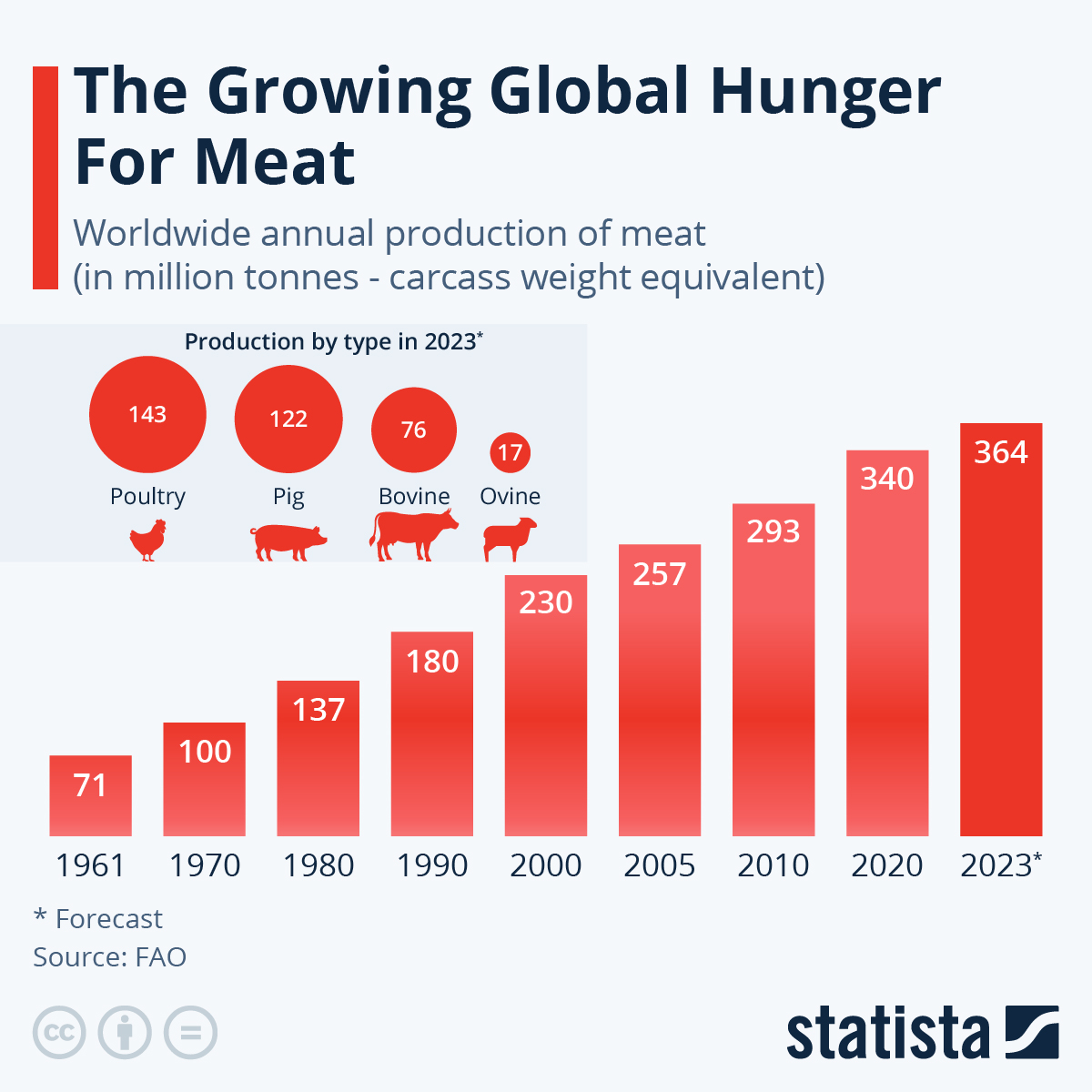
Who’s top of the global league in land-based meat consumption? It’s chicken, but that wasn’t the case 12 years ago. Whereas ALL the major meats (chicken, pork, beef, lamb) have seen global market growth since 2013, chicken has screamed ahead tipping pork from the top position: in 2025, chicken has a 41% global meat market share (up from 36% in 2013), pork has a 34% share (down from 38%), lamb holds steady at 5% through this period, and beef has slipped from 22% to 20% global share (Gira estimates). Over this12 year period, our world population has increased by 1 billion and is responsible for driving the 20% total increase in meat volume sales. However, if your measure is meat consumption per capita, chicken rose by 23%, minor meat lamb saw some growth, whereas pork and beef drifted lower.

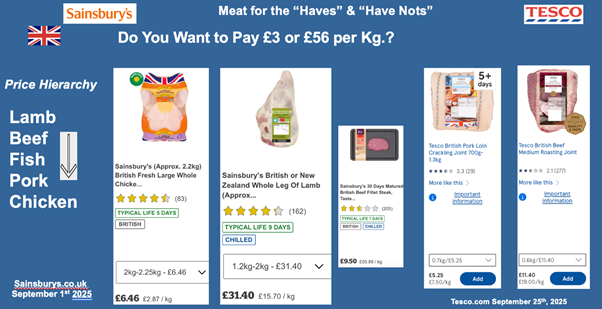
Likely, the position of red meat, struggling since the pandemic through a prolonged “cost-of-living crisis”, from a consumer perspective, will continue to see thin times in terms of growth. Browse the UK supermarket shelves for your Sunday roast: chicken is astonishingly affordable at less than £3/kg.; pork at £7.50/kg.; leg of lamb at £16/kg.; and beef at £19/kg. – a clear indication that there are meats for the “Income Haves” and for the “Income Have Nots”. The latter, often, 40% or more of all households perceive they have little option than to seek high calorie-low price meal options for their families – a 30 pack of breaded chicken nuggets, plus 1.5kg. of frozen French fries, and, say, 2 “snacking” small pizzas costs £4.65 ($6.26) to feed a family of 4 or 5 from Tesco (and these items are all Aldi price-matched). That amount will barely buy you a couple of lamb chops!

Consumers are not doomed to a low-income growth future and, in many countries, when the tide turns, meat consumption will tick up. People in richer countries tend to eat more meat and, certainly, more premium meats. There are outliers where incomes are relatively low but beef consumption is high – BBQ-loving Brazil with its churrascos and Argentina with asados come to mind. Mind you, high income countries don’t necessarily see sustained growth in meat consumption and the UK is a case in point. Our per capita meat consumption has drifted down over the past 20 years, BUT overall meat market volumes have grown as our total population has increased by 10 million over this period. Like most European countries, Australia & New Zealand, USA and Canada, population growth has been driven by incomers and reminds one that it’s handy to keep a tab on the meat preferences of the newer arrivals.

So, in the UK are we going off meat? Far from it! We’re eating less meat per person but we’re not eating meat less times. Our meals, even savoury snacks, may be meat-based but there’s less meat in meat portions, ready meals, sausage rolls/pasties, etc. and we are an ageing country. Old folk eat less. UK median age is 41 but that makes us youngsters relative to Germans (46), Italians (48) and the ancient Japanese (50)! And look, with some country exceptions (e.g. Bangladesh), the world loves meat and are VERY reluctant to give it up notwithstanding exhortations about the impact of animal production on the environment and on our health if we are meaty over-indulgers. Meat consumption is in our genes. As the brilliant cartoon showing stick like stone-age figures hunting game advises “We have never found a cave painting of a salad”!

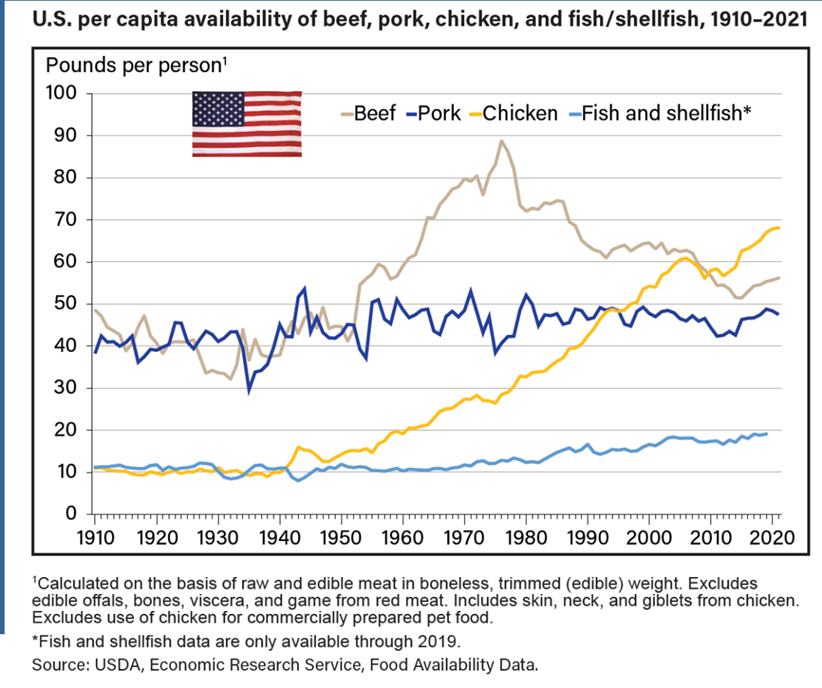
In the USA, poultry (specifically, chicken) is King of The Coop. Overall meat consumption continues its slow but seemingly inexorable upward movement and reminds one that, in America, if something is worth doing, it’s worth doing to excess! Of the 100+kg. per capita of meat consumed each year, poultry accounts for 51% of total, up from 25% back 50 years ago, beef’s share has dropped from 45% to 26%. Per capita pork consumption was above chicken in 1970 at around 25kg. and it remains at this level to this day, whereas per capita beef consumption has declined by 33%. Lamb is essentially a specialty meat in the USA and the cayotes eat more domestically produced lamb than do its citizens!

Addressing the market position of chicken, why is it so successful? Straight off, it’s relative low price and, through time, the relative ease of deconstructing the carcase with machinery not labour. But, back to the USA again. In 1970, per capita chicken consumption was 22kg. (18kg. in UK) and by 2024, it was at a meaty 53kg. (35kg. in UK). In the 1950s in most British families, chicken was for Christmas, now, it’s “Chicken Tonight”! Chicken has been consistently closer to the consumer and to emerging trends than the red meats. McDonald’s NPD and promotional oomph has been helpful – in the USA, it launched “Southern Style Chicken Biscuits” for breakfast in 2008 and pushed the chicken breakfast boat out comprehensively nationwide with Chicken McGriddles in 2020. The relaunch of the McDonald’s Snack Wrap in July 2025, gained international headlines in the popular press. If you can add another eating occasion (e.g. breakfast, mid-morning snack), then, whoop-de-doo!

As diets around the world have become more international (e.g. Indian, Mexican, Chinese, Thai), the focus has been more on the sauce than on the meat species and, because of its price, chicken has become the default meat option. Additionally, chicken meals are seen, often, as being more versatile and family-friendly than other meats (kids like chicken, well nuggets) and have no religious barriers. As life has picked up speed, we’ve changed the way we eat and drink. More recently, traditional meal patterns (“3 meals a day”) have fallen away and now, mini meals and snacks are increasingly prevalent. As Kantar aptly puts it, “what was once called “convenience” has become something more – flexibile (and, a vital companion, affordable). It’s more than grabbing something on the go or just being super quick, it’s about finding food and drink that can bend, twist and fold itself into the unpredictability of modern life”. That’s chicken!

Keep your eyes on Generation Z (i.e. consumers who are in the age range 13 to 30). They’re 4 times more likely to select “grab & go” meals/snacks than ageing boomers. How do they define convenience? Succinctly, now means NOW. Processed chicken products are the default choice and air-frying the means of final meal preparation. Increasing protein intake is fashionable for those in their late teens and early twenties. Again, chicken fits the bill. In the UK, the range of The Gym Kitchen products hits the mark. In the USA, Tyson offer NFL Kansas Chiefs nuggets. What about Liverpool FC “Reds” chicken bites? Keep in mind, meat isn’t the only protein source, and the market is getting crowded, not least with dairy products and nuts.

 Captain Birdseye’s seafaring days may be limited. He’s heading for the shores and the chicken shed – note BirdsEye chicken (not fish) fingers, and chicken (not potato) fries. Perdue “Sea Creature chicken nuggets” has enough cheek for another row of teeth with its “fun shapes of fish/turtles/shrimp/octopus” made from chicken.

Meat sticks are becoming America’s favourite new snack, and we’ve moved on without displacing biltong. There’s room for all meats to do well here but, in the UK, chicken snacks are leading the charge. There’re even crisps (chips in the USA) made from chicken breast and chicken crackling (fried chicken skin) sitting aside the traditional favourite pork scratchings.

Remember that close to 40% of UK households have a family member that isn’t human – the dog, that is, not the difficult partner or child. Mabel, the “Sprocker” in David’s home, demolishes 1kg./week of Tesco’s chicken thighs giving her a per capita consumption 50% above average for our nation! Spoilt rotten? Undoubtably, but at £3/kg.  courtesy of the low fresh chicken price, it’s the same cost as a can of Butcher’s Tripe dog food! 

Will chicken retain its paramount position amongst meats? Browse the meat aisles in our supermarkets. Chicken gets 3 times the shelf space of beef and 5 times that of lamb (for goodness’ sake, in Waitrose, Charlie Bigham’s posh ready meals get double the space of lamb). Pork holds its own courtesy of serried shelves of bacon and sausages. But, move over an aisle and you’re into stacks of prepared meals, easy meals, the “that’s dinner sorted” and snacking & sharing sections. In these areas, chicken has a disproportionate share of the protein on offer. In short, we’re nowhere near “Peak Chicken”. Pork, in its processed form, has opportunities here to build on its traditional base of cured meats and expand its snacking offer.

As food retailing and food service converge, which is happening at pace particularly in the UK, meat isn’t sold as meat cuts, per se, but as the meal and/or snack solution. As those Gen. Z consumers grow older, they’ll require a shopping assistant to show them where and how to buy raw meat. For them, it will be an exciting outing enjoyed once or twice a year, like going to the zoo!

For domestic producers of meat (i.e. farmers producing livestock for their national market), a worrisome implication of the trend towards consumers eating meat more in processed form than fresh is that it increases the opportunity for lower cost international meat producers to broach new markets – for example, if pork or chicken are the ingredients in a “value-added” processed meat product rather than the product itself, as they would be if on the chilled meat aisles of a supermarket, the less notice consumers will take of the origin of the meat ingredients. This risk is similar for meat sold via value/cheaper food service outlets – most consumers don’t ask “where does this chicken come from?” when buying fried chicken or nuggets at the end of a boozy night out, or when tired children are screaming for food towards the end of the afternoon of a family outing!

To finish, seafood competes directly with land-based meats for the household protein and “Centre of the Plate”. Rabobank advise that “seafood is poised to surpass poultry as the leading contributor to global protein supply growth”. Sea creatures are the Number 1 meat in Portugal. In many Asian countries, seafood consumption is at or above “chicken levels”. Some fish species can compete on price with chicken – Pangasius, a pond fish, aka catfish or Basa. It’s a tasty fish for the “Income Have Nots”, whereas “Income Haves” can feast on wild salmon, tuna and lobster, with middle incomers selecting farmed seafood such as salmon, sea bass and prawns. If you’re in the meat business, then, you’re into protein whether it’s produced on land or in the water.

Keep in mind that the world’s biggest packaged food company and, certainly, the largest protein company is the Brazilian behemoth JBS (food revenues of close to $80bn. in 2024). JBS started in beef, added pork, chicken and lamb, moved into farmed salmon and has just acquired a company to make it the largest egg producer in South America. Its intent? To consolidate and enhance its position as the world leader in protein for human consumption. There must be something in the water in Brazil! Its biggest competitor Brazilian company Marfrig (the world’s 7th biggest packaged food company) has just gained approval to merge with BRF (Brasil Foods) to increase its international competitiveness. Four of the ten largest food companies in the world are in the meat business. The big are getting bigger presenting challenges to those “stuck in between” as to where and how they can differentiate their products and services and best ply their trade.

David Hughes and Miguel Flavian

        October 3rd, 2025

Tagged with: , , , ,
Posted in Uncategorized

The Giant Pumpkin in The Fresh Produce Room: Declining Consumption Across the Globe! Can We Reverse the Trend?

Wherever one looks. North America, Europe, Australasia, Japan, per capita fresh fruit and vegetable consumption is drifting downwards. What’s going on? Everybody knows that they’re essential for our health but very few of us get even close to meeting our 5-a-day targets. The UK Eatwell Guide and the New Zealand equivalent infographic are resplendent with fresh produce which look pretty on the kitchen wall, but they attract dust rather than attention! Fresh produce market volumes may show a slight increase, but these are driven by rising population not individual households eating more.

The most influential factor constraining growth in many countries is the rising retail prices of fresh fruit and vegetables. Recent Reserve Bank of New Zealand research notes price increases of 45% between 2014 and 2023 outstripping those for processed foods which rose by only 14%. For those households challenged to pay their mortgage/rent, grocery bills, energy and transport costs, etc., and such numbers have mushroomed during the 2020s, filling family member tummies has become a price per calorie battle and processed foods, typically HFSS (high fat, sugar, salt), are a fraction of the cost per calorie of most fresh fruit and vegetables. The UK Food Foundation calculates that “value” ready meals and processed meat are half the calorie cost of fresh fruit & veg. Dismally, escalating fresh produce retail prices are not necessarily reflected in higher prices to farmers. Their production costs have risen disproportionately, and their margins squeezed by ferociously competing retailers. What hasn’t helped has been extreme weather in many parts of the world causing supply chain disruptions driving prices even higher. Processed food companies have been more adept at capturing the eye of the food consumer through tracking and responding to consumer trends and launching promotional initiatives whereas fresh suppliers, typically, have focused on producing and relying on their retail customers to present and promote produce as they seem fit!

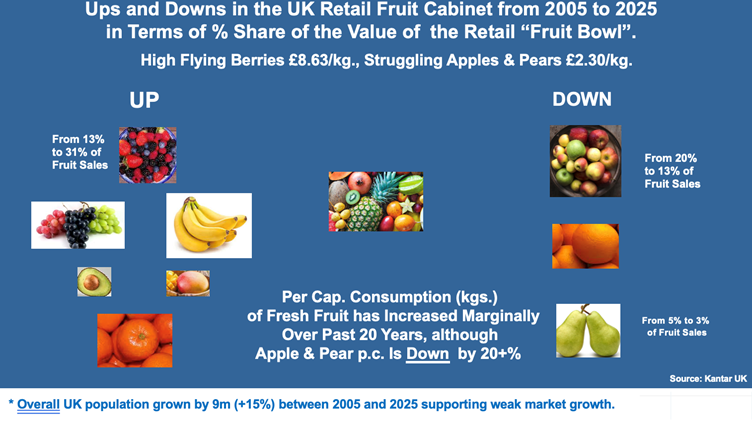
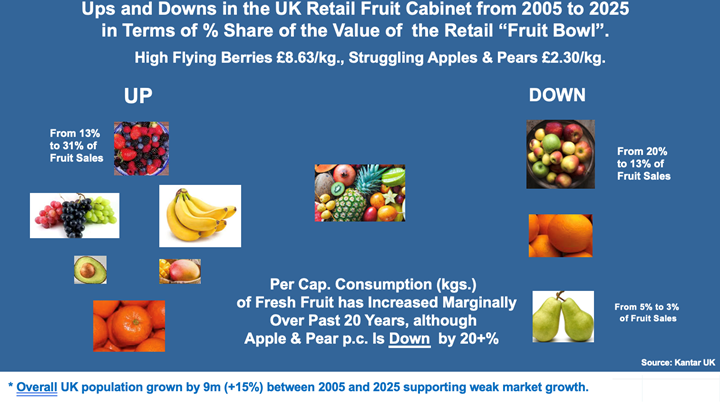
So, when it comes down to selecting our food products, is it only about price? Not necessarily. Take the UK fresh fruit market where the outstanding category over the past 20 years has been fresh berries. This year, fresh berry retail sales are 30% of the total retail value of all fresh fruit. 10 years ago, that figure was 20%. Yet, fresh berries have an average retail price/kg. 4 times that of apples which have seen their value market share of the UK fruit bowl slip from 21% to14% over the same period. Clearly, shoppers will pay more for what their families enjoy even although it may pinch their purse. The success of fresh berries has been global: taste and 52-week availability have been transformed; they’re snackable and firm family favourites. In the UK, casting back over the past few decades, snackable fruit such as berries, grapes, easy peel citrus have burgeoned whereas traditional favourites such as apples, pears and oranges have floundered. Mind you, the world’s most consumed fruit, bananas, combines snackability, strong kids’ acceptance and low price – feel sorry for Latin American producers because, in the UK, retail prices for bananas are the same as they were 20 years ago. At less than £1/kg. bananas are essentially a “free good”.

It’s a truism that fresh fruit and veg. are indispensably healthy but are perceived to be expensive. In consumer surveys across the globe, a common response is “I’d like to buy more but they’re kind of expensive”. Yet, many urban workers spend twice as much on their coffee purchases in the week than they do on fresh fruit & veg. for the entire family! Sadly, fresh produce is not addictive like coffee, nicotine and alcohol. The challenge is to present fruit & veg. in a form that meets consumer requirements and to communicate its cracking value for money and contribution to family health.

Whilst fresh fruit & veg. per capita consumption may be down in the dumps for some produce, but that’s not the case for frozen produce. In the UK, both frozen fruit and vegetables have seen modest but consistent upward movement over the past decade, accelerating through and after the Covid period as households saw advantages of frozen in terms of price, storability (shelf life) and reduction in food waste. Focussing on vegetables, it’s probable that this trend may be longer-term. Clarence Birdseye gave them a start in 1929, not least with peas and, in the 1940s, the Simplot Company caused a splash with frozen French fries. Who shells peas from fresh now or peels and slices potatoes to fry on the stove for chips? Cadbury’s iconic Smash Martians popularised “instant” mash potatoes in the 1970s (remember the advert.? “For Mash Get Smash”) and the brand is still on the UK market courtesy of Premier Foods even now. However, chilled mash potatoes for long a popular item in the USA (Kroger supermarket chain has 386 chilled mash products on its website) are now having a day in the UK and elsewhere. Tesco has 20+ mashed potato products online and the standard own label mash at £1.32/kg. (US$1.77) with a Clubcard is a snip.

Consumers aren’t quick to embrace new forms of traditional products, but they do move along a continuum, taking chilled mashed as an example, from Never to Occasional to Routine purchase through time. Convenience is an overwhelming driver! It’s a route that is likely for vegetables that are most under the gun in terms of family acceptance – such as “the hard veg.” beetroot, carrot, parsnips, squash, sweet potatoes sliced, frozen and ready for air frying. Chilled, chopped onions are another value-added product that is edging its way into the fridge of would-be meal preparers who are short of time.

What of frozen fruit and ambient processed fruit products. They don’t count in our measure of fresh fruit, but they are pervasive and growing in demand. We train our children to consume fruit from pouches. They progress through childhood into early adulthood swigging fruit smoothies. Per capita fresh pear consumption is dwindling in the UK. Indeed, every time David sees a hearse go by, he’s anxious on 2 counts: could it be one of his mates; and, for certain, there goes another pear consumer given the ageing demographic of the UK fresh pear market! The baby that sucks from a pear pouch will progress to slurping a fruit smoothie snack (1 of your 5-a-day) and on to the giddy heights of a super smoothie as their fruit palette sophistication blossoms to enjoy squished lychees, apples and dragon fruit with extra vitamins. Frankly, if you gave most UK teenagers and early-twenties a fresh whole pear, they wouldn’t know what to do with it!

Returning to the giant pumpkin in the room, i.e. declining per capita fresh fruit & veg. consumption. Does it matter? Well, yes if you believe that fresh fruit & veg. have a contribution to improving the dietary health of the world. Notwithstanding the emerging prospect that AOMs (Anti Obesity Medications) are arriving, like the cavalry, to stem the global obesity crisis. Worldwide, governments are desperate to encourage healthier eating. The UK has released a 10-year plan for our creaking National Health Service and has an agreement with major food retailers and manufacturers for them to report, using an accepted nutrient profiling model (NPM), progress in increasing the proportion of healthier (i.e. non-HFSS) foods and achieving stretch targets. This sounds positive for those in the fresh fruit & veg. business! Our major supermarkets are in concert with the aims: Tesco will reward customers with extra Clubcard points for buying more fresh produce; Sainsbury’s has a somewhat more complex programme, based on its Nectar loyalty card, for those buying “Healthy Choice” food products. Others across Europe are on the same page. Even the normally disciplined, super fit, stick thin Swedes (the nation not the vegetable) – ICA the grocery market leader in Sweden is lowering prices for key fruit and veg. items and launching “Join the Fruit Reboot” presenting fruit in a more modern, child-friendly way (only 1 out of 10 Swedish children achieve their 5-a-day target). In the UK, VegPower has seen success in casting vegetables as villains and calling on children to “Eat Them to Defeat them”. In Australia, the International Fresh Produce Association (IFPA) has launched its “Fruit and Veggies Yummy Yummy” campaign with The Wiggles Family encouraging children to explore, cook and enjoy fresh produce. All of these initiatives are helpful but far from being sufficient.

To revisit the 2 principal reasons why per capita fresh fruit & vegetable consumption is declining. First, exacerbated by many households being in “a cost-of-living crisis”, there’s the high cost per calorie of fruit & veg. and, even when through retail promotions fruit & veg. can be astonishingly (from a producer perspective, worrisomely) affordable, it’s perceived to be “kind of expensive”. Yet, in the UK, average weekly household spend on fresh fruit & veg. is only £12 (US$16). Second, even although most shoppers intrinsically know that serving more fresh fruit and veg. is in the best health interests of themselves and family, if the kids don’t like it and if it takes time, and for some, knowledge to prepare it, then, we’ll skip it and buy something pre-prepared. These are tough negatives but, onwards! We must accept that convenience invariably trumps health concerns. How a Baby Boomer (60+ yrs.) defines convenience bears no relationship to how a Gen. Z (13-28 yrs.) defines the term. Going forward, fresh fruit & veg. will increasingly be sold in a “value-added” format – removing labour and need for expertise from its preparation and use in meal/snack-making. Remember, whereas David’s Mum used to pop down to the grocer to buy ingredients, Gen. Z are not even familiar with the term and simply seek meal and snack solutions.

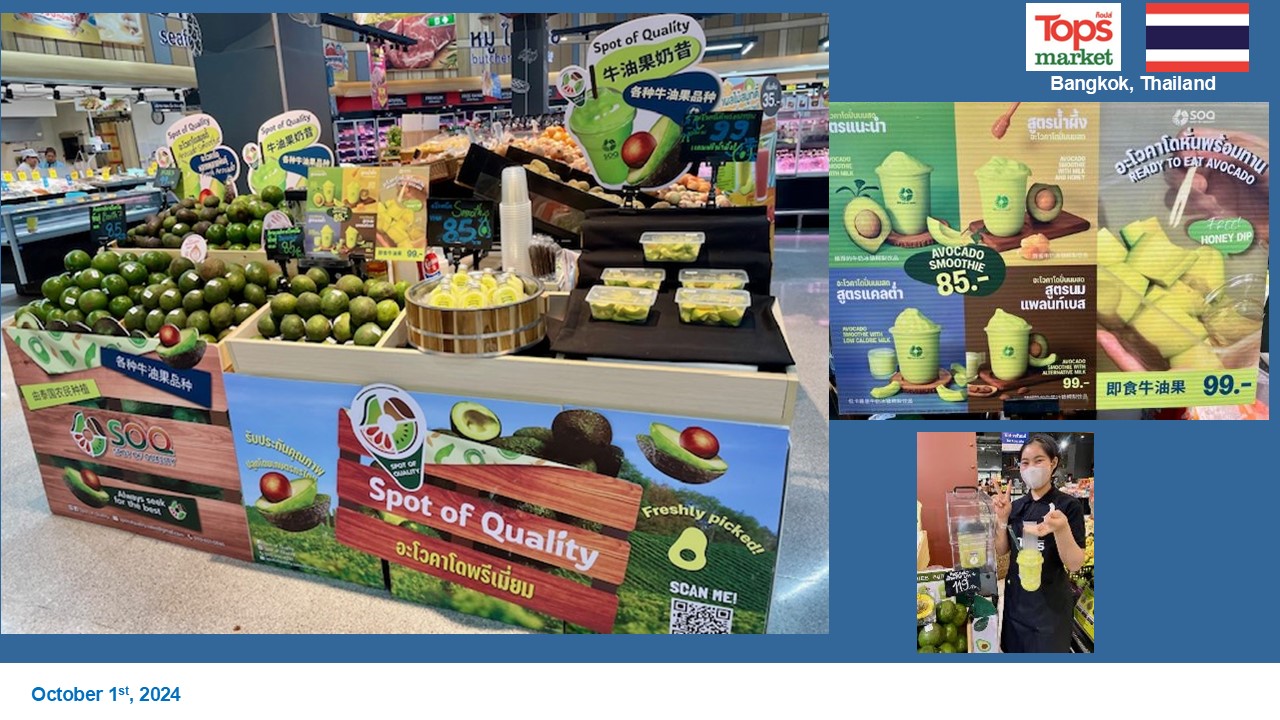
Retail presentation can be much improved for fresh produce, often, by simple cross-merchandising. For, say broccoli florets, make sure they’re adjacent to appropriate dips, sauces, hummus, etc. Marks & Spencer place the cream next to the strawberries. Avocados are in vogue and place the whole fruit next to the guacamole and avocado smoothies. For any fruit and vegetable item, take a leaf out of the avocado marketing book and create/magic up another eating occasion for your product – smashed avocado as a breakfast emerged in Australia in the 1990s and quickly became fashionable around the world. Is there a TikTok marketing opportunity for you? – check out the Canadian TikTok cucumber salad champion who rocked the global cucumber supply world!

To finish, fresh fruit and vegetables are widely considered the quintessentially healthiest food category. Yet, consumers elect frequently to ignore this attribute in our choice of food. We observe that within the fresh produce departments of most supermarkets, there is VERY little noise made about the specific health attributes of produce. If you want to know about how healthy berries and cucumbers are, go to Boots the Pharmacy and browse the beauty product shelves!

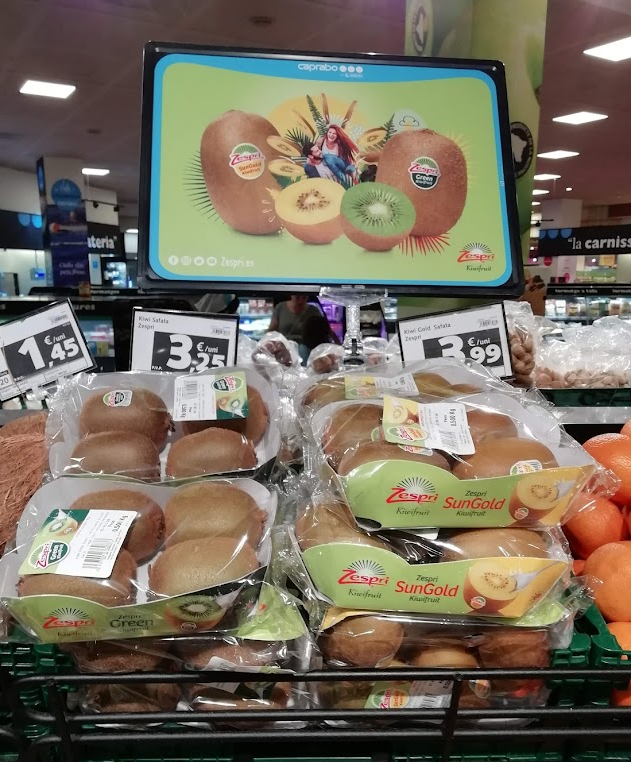
Some internationally branded fresh produce companies do promote their products on health – Zespri comes to mind (their kiwifruit vitamin C content being double that of oranges!). In China, Joyvio. the blueberry brand leader identifies eye health as the key attribute.  Why is the fresh produce industry so shy in front of the shopper? Is it because we have a commodity orientation and who’s going to pay for the promotion? Scottish premium salmon trumpets that 1 salmon fillet provides our omega 3 requirements for the week. It’s important to identify the specific health benefits that attracts each consumer group – such as heart health for the older, skin health particularly for women, brain health for Mums (not theirs, their children!). At a time when consumer concerns about UPFs are on the rise, make sure that on your front of pack you have your ingredient list, e.g. for carrots, state Ingredients: Carrots!

If you’re still with us, Thanks. Do enjoy your Summer in the Northern Hemisphere and wear wool next to your skin in the furthest southern part of the Southern Hemisphere.

David and Miguel.

July 2025

Tagged with: , ,
Posted in Uncategorized

What’s  the Global Story and Outlook for Fresh Fruit and Vegetables?

If you’re in the fresh produce business, you’d think it reasonable to conclude: “right time, right place”! Around the globe, consumers put “eating more healthily” pretty much at the top of their “To Do” list for 2025 and it’s for good reason as, increasingly, the majority of the population are as round as puddings. Prestigious medical journal The Lancet forecasts that more than half of adults and one-third of children worldwide will be overweight or obese by 2050. Yet, eating healthier is easy to say and, clearly, difficult to do. Eating more fresh fruit & veg. would be a good start. And that’s exactly what people aren’t doing! What’s the story?

Take higher income countries, across the EU, UK, USA, New Zealand and Australia, longer term per capita fresh produce consumption has trended downwards – although market volumes may have increased driven by increases in population. Economic downturns are not a friend of the fresh produce industry and the current “cost-of-living crisis” is a case in point. In regular times, fruit and vegetable consumption by lower income urban families is significantly less than in better off families. When the purse is pinched, this is simply accentuated. Through the past few decades, cost per calorie of “value”, albeit unhealthy foods, such as some cookies, cream cakes, skimpily covered pizzas have become substantially lower than healthy foods such as fruit & veg. and they provide convenient, low-cost meal solutions and assuage hunger whereas salads, cabbage and apples don’t! Most Western countries are far from achieving anywhere near their 5-a-Day F&V targets (exceptions being Greece, Belgium, Italy, Portugal, and Poland) and there’s been a pervasive drift, across most continents, towards an American-style diet, i.e. one characterised by a high proportion of the controversially defined Ultra Processed Foods (UPF). By the bye, females are more fresh produce friendly than males, particularly if they have small children (and the urban myth is that a Glaswegian male is more likely to be seen doing needlepoint than eating fresh fruit!).

The market is flooded with convenient solutions to fix a meal in no time.

So, do we just need to lower prices to increase consumption of nutritious fresh fruit & veg.? No and, fresh produce growers, park your anger for the moment at the thought of doing such! Here’s a mini case study on the UK fruit market. Keep in mind that this market is largely serviced by imports – 56% from outside Europe, 28% EU, and a modest 16% home-produced. Over the past 15 years, per capita fresh fruit consumption has seen a tiny increase (3%) and is about 40kg/cap. From 2010 to 2024:

  • Total fresh fruit retail market value increased from £4.1bn to £7.2bn and volume from 2.47m to 2.8m tonnes while UK population increased from 62.8m to 69.1m;
  • In volume terms, bananas continue to be the UK’s favourite fruit, followed by apples, and citrus but all three have slipped in the consumer’s affection, whereas the composite category berries have close to doubled their share, tropical fruit have advanced significantly and grapes have edged forward. Pear volume share of the market has nigh on halved (with the worrisome thought that, given the demographic profile of a typical pear eater, every time one sees a hearse go by, there goes another pear consumer!);
  • Is price driving consumers’ choice of fruit category? Perhaps surprisingly, NO! Fresh berries have a retail price point/kg. some 4 times that of apples and pears, and 8 times of bananas, yet from 2010 to 2024, fresh berries have increased their value share of the retail fruit bowl from 17% to 29% of total and look on course to taking a full one-third of retail fresh fruit sales by decade end (with blueberries leading the charge). Bananas, at £0.99/kg, are essentially a “free good” and have seen less than a 10% increase in retail price over the 15-year period, whereas average retail apples prices rose 47% from £1.45 to 2.13/kg and berries by 48% from £5.71 to £8.47/kg. Do such increases compensate fruit growers for input cost increases? Far from it. For berries, labour costs account for around 50% of total costs and minimum wages have doubled from 2010 to 2025;
  • The UK is an intensely price competitive market with supermarket own label products dominating. The 2 principal hard discounters – Aldi and Lidl – have had huge success in expanding fruit value market share from 6% to 22% at the expense of traditional supermarkets and the dwindling independent trade ensuring inexorable downward pressure on retail F&V prices;
  • Low although prices may be, there’s positive news for the UK fruit industry in that retail fresh fruit market volumes peaked in the tragic home-incarcerated Covid years of 2020 and 2021, then declined in 2022 when we were “released” but recovered in 2024 to close at the previous peak levels;
  • Of course, consumers have other choices than just fresh F&V and, particularly for vegetables, in the UK the Covid period saw a boost in frozen purchases driven by its longer shelf life, perceived convenience, less waste than fresh, improvement in consumers’ perception of the nutritional quality of frozen produce, and the relative price competitiveness of supermarket branded frozen vegetables. Best keep an eye on which veg. will follow the lead of frozen peas and French fries. Chilled ready mashed potatoes are becoming a routine purchase for many households and, looking to the future, frozen chopped onions and garlic look likely candidates for sales growth. Constraints to the expansion of frozen include availability of freezer space in the home, and concerns about “additives” in frozen products.
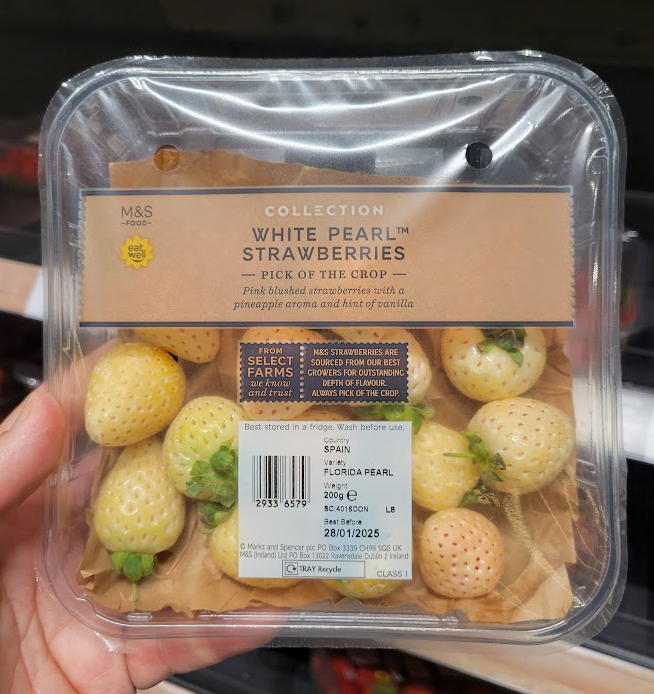
Pineapple aroma and a hint of vanilla… it’s not your wine, it’s a pale strawberry!

Major factors underpinning the success of relatively pricey fresh berries in so many markets include: they’re perceived as a treat (and even in stringent economic times, who doesn’t need a treat?); loved by children; crucially, they’re convenient (you don’t have to peel them!) and intrinsically snackable; seen as health heroes, particularly blueberries; widely available year-around which encourages weekly “routine purchases”; emergence of berry brands and “good/better/best” tiers; and, like some other fruits, accelerated investment in R&D has delivered notable improvements in the qualities appreciated by customers (e.g. consistent delicious taste). Zespri’s Kiwi Gold and RubyRed kiwis are good examples of combining the power of intellectual property and branding to “decommodify” the more generic green kiwifruit category. All produce items need to avoid “the commodity trap” epitomised by bananas – with 99% of those internationally traded being the Cavendish variety. Famous brands are associated with the fruit – Dole, Chiquita, Del Monte, Bonita, Fyffes and more – but few, if any of these generate a significant brand premium (would you switch supermarket because they’re out of Dole bananas rather than your regular Chiquita ones?). Bananas have the dual function for the supplier of delivering huge volume in shipping such that they can inexpensively add on other higher margin produce.

Returning to the healthiness of fruit and vegetables, where can customers garner compelling claims as to the benefits of fruit and veggies – the fresh produce aisles of supermarkets? No – wander around pharmacies such as Boots and note that cucumbers and berry extracts are lauded for their skin beautification properties. In the premium juice and smoothie aisles of supermarkets, product labels are crammed with claims relating to F&V portion equivalents which can be ingested with a few glugs in seconds! Tesco.com is a case in point: there are hundreds of fruit and vegetable drinks, juices and smoothies on offer: e.g. happy monkey smoothies … and on front of pack “made for kids with 100% fruit, No Bits (God forbid!), no additives or added sugar, 1 full portion of fruit, great for lunch boxes”. Are these fresh fruit and veg. competitors? Sure, why bother buying the real thing? In the fresh produce industry, we’ve largely relied on others to make motherhood claims about our F&V. But, claims that they are “a good source of vitamins and minerals” are insufficiently visceral, they don’t connect. At a time when consumers say they want to eat more healthily, they seek specific credible information on what the benefits are to me and my family (and, more challengingly “how long before I can see the benefit?”). Joyvio, the leading fresh blueberry brand in China, hits this nail on the head – its claim that blueberries improve/are essential for eye health is widely embraced by consumers.

Across the globe in the fresh produce industry, rapid change is afoot. Commercial horticulture is simply increasing in scale. The investment cost to be at the leading edge of fruit & vegetable production is accelerating through this decade and will continue to do so. Mid-20th Century saw the global “Green Revolution” fuelled, in part, by significant public sector funding (e.g. World Bank) but, now, the “HortiTech Revolution” is dominantly private sector funded and there’s a substantial entry cost for those horticultural businesses wishing to be on board. You want to reduce in-field labour costs and cut out herbicides? The smaller  “LaserWeeder” costs you US$600K and its big brother $1.5m. Harvesting robotics are still at an early stage but will be with us at decade end as will profitable, albeit eye-wateringly expensive, advanced vertical farming. Horticultural crop breeding is being transformed by a combination of AI and gene editing (e.g. look at what Heritable Agriculture and AddGene have to offer). Just as we are seeing polarisation of income in consumer markets, i.e. household income “haves” and a high proportion of “have nots”, there’s polarisation in horticultural businesses, for example: fashionable, high growth berry and avocado sectors are seeing massive consolidation (note the acquisition journeys of Driscoll’s and Westfalia Fruit); in Australia, 10 horticultural businesses, some infused with private equity investments, account for over 50% of fruit & vegetable sales; branded bag salad giant Taylor Farms in the USA is investing in the European salad sector; G’s Fresh in the UK with $1bn sales of salads, celery, beetroot, asparagus, onions and more identify wherever they can establish a Number 1 or 2 supplier position with UK supermarkets; in varietal development and licensing, Sun World International for fruit and Sakata for vegetables are expanding; and, of course in frozen potato products, McCain’s, Simplot, Lamb Weston and Aviko sit astride the rapidly expanding world of frozen French fries.

If the Big League horticultural players have, inter alia, economies of scale, financial capacity to harness technological innovation, ownership of/exclusive access to valuable varietal intellectual property (IP), a consumer relevant brand and a suite of major supermarket customers, where does this leave smaller-scale fruit & vegetable businesses? In short, they’re scrambling! Food producers across the world are grumpy but horticultural growers are a step above grumpy and into incandescent rage territory.  For example, one-third of Australian vegetable growers are considering exiting the industry. It’ll be a similar figure for UK fruit growers who have only a small proportion share in their home market. Can growers strengthen their position? Options can include aligning their own businesses with those with IP and brands, for example:

  • the New Zealand Government-owned Institute for Plant & Food Research is adept at developing partnerships with grower-owned Zespri, the No. 1 global kiwifruit exporter, and with venture capital-owned Rockit exporting “mini-apples in a tube” to 20+ countries;
  • California-based Sun World was a pioneer in the fruit industry to work with select growers and marketers worldwide in introducing new varieties of grapes (e.g. Applause and Epic Crisp last year) and stone fruit;
  • Japanese seed company Sakata partners with marketing organisations in Europe (Bimi/Tenderstem), USA (Baby Broccoli), Australia (Broccolini) who work with local growers to produce the popular green vegetable which is a cross between Chinese Kale and broccoli and sells at a substantial price premium to commodity broccoli. Apple & Pear Industry Australia representing Australian apple and pear growers uses a similar approach to Sakata in marketing Pink Lady apples around the globe. Pink Lady are grown in Australia, New Zealand, Europe (but not yet in the UK), South America and South Africa and achieve a mouth-watering price premia in Europe and beyond;
  • G’s Fresh in the UK works with growers and cooperatives in the UK, Poland, the Czech Republic, Spain, and Senegal to supply salad crops and vegetables (largely supermarket customer branded but with some G’s brand such as LoveBeets) to major retailers in the UK;

Should small-scale horticultural businesses consider using their scarce resources in other ways? Why wouldn’t you if you were beating your head against a wall! But, smaller-scale can work in servicing very local markets with strong customer connections, and/or wider markets with more niche, specialty fresh and processed products. In the UK, the tiny Isle of Wight provides examples – The Isle of Wight Tomatoes with its fresh tomatoes and tomato condiments, and The Garlic Farm with fresh garlic, plus a host of processed garlic products and tourism. David has his own personal experience as co-owner of a small hydroponic herb farm in Florida which developed a range of branded packaged fresh products selling consistently at a premium to the commodity herb market. But, keep in mind, whilst Ernst Schumacher advised us that “Small is Beautiful”, in a mid-21st Century commercial horticultural context, small is also fragile and may need support from other income streams!  

David Hughes and Miguel Flavian

March 17th, 2025

Tagged with: , ,
Posted in Fresh Products

The Future Looks Bright but Turbulent for Meat, Dairy and Egg Producers in Healthy Global Markets for Protein Foods

The pandemic may be done and dusted but, by any measure, we’re living in turbulent times. Note to senior management, expect the unexpected! Mind you, we’re not going to run out of customers: over the next 25 years (up to 2050), world population is forecasted to increase by 1.4bn with almost all the extras being in Africa (+920m) and Asia (+450m) and a fair proportion of these will be Moslem or Hindus with meat protein implications to mull on for those in pork and beef. The European and North American share of global population will have shrunk from 17% to14% of total. Globally, average total food consumption is increasing by 6.5kg per person per year but, like the expected population increase, it’s not well spread out: 10% of our world are seriously under-nourished whereas 20% are obese and, in North America and much of Europe , 40+% are as round as puddings and are an unnecessarily “heavy weight” on our health systems. Plant foods – cereals and vegetables – top the food league table, although meat, dairy and egg products are global favourites where they can be afforded.

Focusing on meat, ALL the major meats have seen market growth over the past decade or more, but chicken continues its inexorable growth in global meat market share, usurping pork in 2017 to account for 40% of all ‘land-based meat” consumed in 2024. The “minor” meat lamb accounts for 5% of total with beef holding on to 20% or so share. Oddly, meat statisticians and “Big Meat” internationally, often, don’t appear to consider seafood as being a meat protein choice for consumers, yet fish & seafood are preferred options in much of Asia and Rabobank forecasts that seafood will contribute the largest gains in global protein supplies in 2025 and on, dethroning poultry as the growth leader. The future of plant-based “mock meats” and cell-based meat? Clearly, the former are on the downward curve of the “Gartner Hype Cycle”, not surprisingly as consumers thought early versions tasted dreadful, were expensive and had worrisomely long ingredient lists. Cell-based are past “peak excitement” albeit are continuing to attract venture capital with a longer-term view.  Research colleague Miguel asks me “when will cell-based meats attain commercial scale and be on the shopping list of a proportion of consumers?” and my stock reply is “Not in my lifetime ….. (sigh of relief from commercial carnivores) but then, I’m not in the first flush of youth”!

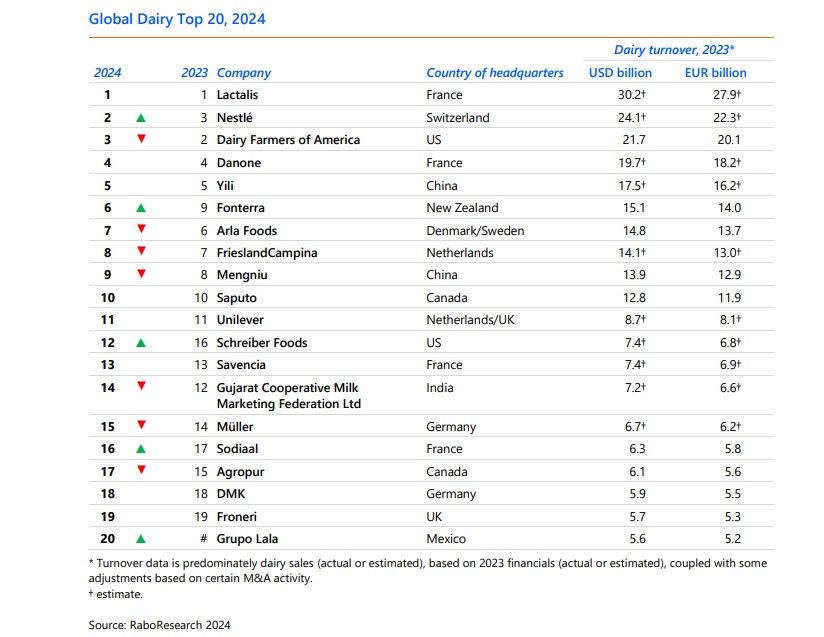
Global dairy is chugging along nicely (dairy products are the world’s 3rd most consumed food group) but their consumer use has been changing rapidly. Plain milk, in a bottle or pouring on breakfast cereals, is yesterday’s use, whereas quaffing a dairy protein shake and woofing down a mozzarella-wrapped pizza is à la mode for Gen Z and Millennials worldwide. The Top 10 of the global dairy processors are advancing at pace, via acquisition, and for good reason – processors with sales of $600+m are up to 50% more profitable (EBIT) than smaller fry.

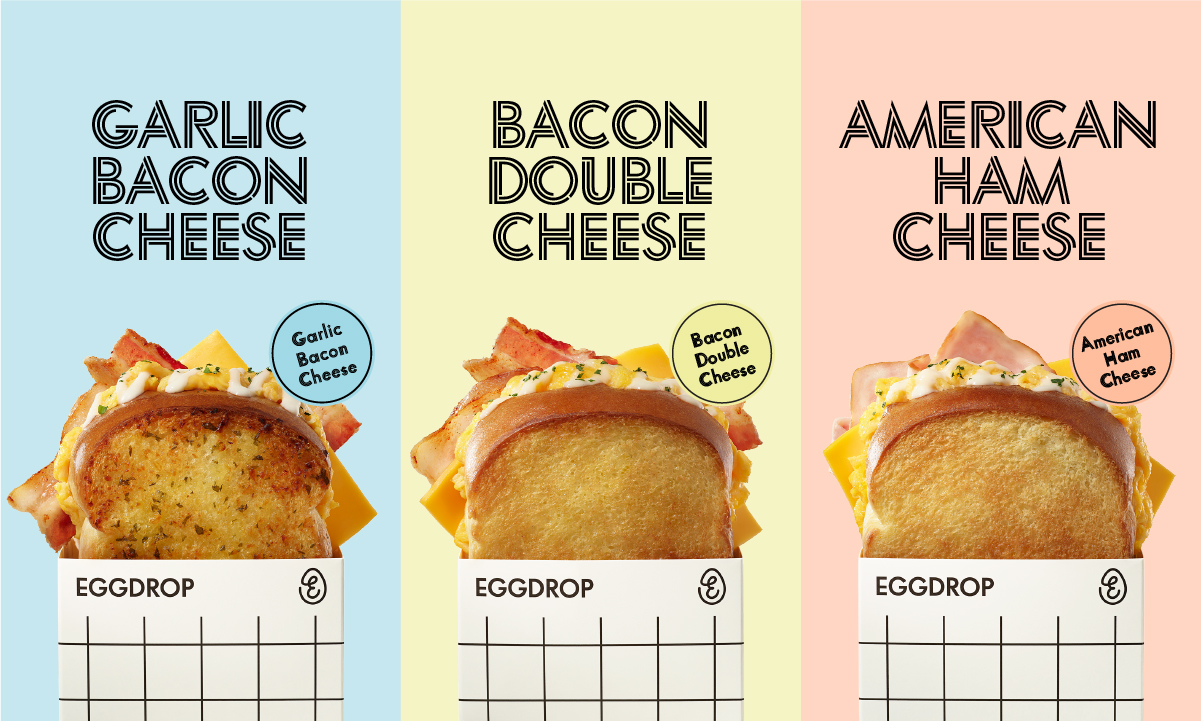
The egg industry future looks similarly rosy to dairy, notwithstanding the scourge and challenges of Avian Influenza. Scale and profitability are important here, too. The USA egg market leader, Cal-Maine Foods, has revenues of $3+bn and collects eggs daily from 45m hens, making this one company larger than the entire UK egg industry. “Kong Meat”, Brazilian giant JBS has just poked its nose into the egg industry through an acquisition making it the largest egg producer in South America. If you want to see excitement in the out-of-home egg market globally, go to Asia where eggy products have long been firm favourites. Try a yummy Korean branded “EGGDROP” sandwich. It’s in Southeast Asia where innovation in food is buzzing. The region has modest population growth (increasing by “only” 55m by 2033), but household income is galloping along relative to slow growth Europe which is indicative of expected strong future demand for livestock protein products.

What of the future of sustainability of global food production? Around the globe, consumers are increasingly conscious of what they put in their tummies has a profound impact on their own health and the health of our planet. Skimming past a range of hugely important global human health issues, the relatively recent arrival of AOMs – new acronym – anti-obesity medication is starting to cause early and frantic stirs of concern on some food markets. AOMs have certainly taken the attention of big FMCG players, smarting over being sat on the UPF (ultra processed foods) naughty step by food nutrition evangelists. Survey results show that AOM users tend to cut back on snacks and fizzy drinks and increase their intake of healthier protein foods which is good news for those producing meat, dairy and egg products.

In January, The World Economic Forum published its annual global risks report for 2025. Looking at the Top 10 risks over the next 10 years, WEF identified environmental issues as the top four most likely to have an impact on business, viz. extreme weather events, biodiversity loss and ecosystem collapse, critical change to Earth systems, and natural resource shortages. In general, and around the globe, consumers recognise that we’re running out of time to fix the problems that could destroy our world. However, saying this and then doing something about changing their purchasing behaviour and, say, reducing in-home food waste and improving recycling is another matter (the “saying but not doing” conundrum). Barriers to consumers shopping more sustainably include perceived expense of “green” products, difficulty in searching for them amongst the thousands of grocery items on supermarket shelves, lack of knowledge about what is best to buy, dissatisfaction about the efficacy of some “green” products, concerns that “big business” claims are, often, simply “greenwashing”, and “I’m too busy and worried about the food bill/my mortgage/rent to worry right now about sustainability ”.

Last year (2024) was the first calendar year that our world reached, indeed exceeded 1.5 degrees Centigrade above the pre-industrial levels and it was no blip! Is it hopeless and we’re doomed to a hellish hot future through inaction? No, although we better get a move on. In 2025, the 30th annual UN Climate Change Conference (COP25) will be held in Belém, Brazil. Back in 2015, most national governments signed a promise to undertake actions on reducing our carbon impact, halving food waste, etc. by 2030. You don’t have to stand on a chair to see 2030 from here and leading “developed nations” are nowhere near delivering the environmental outcomes promised. Yet, the manifestations of global warming are increasingly self-evident (e.g. January 2025 was the hottest January on record) and responsible governments recognise that “needs must” or we will irreparably damage the future of our countries. Try and explain inaction to your grandchildren! Forward-thinking governments are grasping the nettle (e.g. last year, Denmark confirmed the first carbon tax for its farmers) but it can come with a political sting –  note Dutch livestock farmers furious response in 2023 to the threat of being forcibly purchased in order to cut Dutch nitrogen emissions which led to the fall of the government and sharp swing to the right in a shock national election .

In the marketplace, smatterings of meat, dairy and egg products are on-shelf with methane/carbon-reduced labels. The principal retail vendors of most countries’ grocery products, the large supermarket chains, have like their governments made promises, too (e.g. Tesco – carbon net zero across its full value chain by 2050). Contentiously, mind you, because such promises largely relate to reducing Scope 3 emissions which account for the lion’s share of the environmental impact along the food chain and these principally relate to activities on individual farms. Thus, the substantive actions to edge towards carbon net zero must and will be made on farms led by those who are trialling improved management and agronomic techniques, supported by businesses in the vanguard of developing low carbon farm inputs, and accelerated by blisteringly exciting technology such as AI and gene editing. How and when this will all happen is for others more qualified to tell. But, for certain, fast forward a decade from now and livestock products and livestock feed will have significantly lower “Enviro Scores” than they do now.

Around the globe, commercial agriculture is simply increasing in scale. The investment cost to be at the leading edge of food production has accelerated through this decade and will continue to do so. A big green grain combine can cost £1m/$1.25m! Fewer and bigger is the farm business trend across livestock and cropping. Mid-20th Century saw the global “Green Revolution” fuelled, in part, by significant public sector funding (national governments and World Bank) but as we fast forward through the present “Technological Revolution”, private sector funding is dominant and there’s a substantial entry cost for those food producers who wish to be on board. Where does that leave smaller-scale farmers? Scrambling, as ever! For consumer-friendly smaller-scale farm businesses, niche markets which could be local and/or for specialty food products can be attractive if the farm “offer” is accompanied by compelling stories about provenance, family history, production process, etc. Many will certainly require, where and if available, policy support to provide them with income opportunities through “greener” farming, as per in England with its Environmental Land Management payments (aka ELM “public monies for public goods”), more sympathetic planning regulations such that they can diversify into tourism (e.g. glamping) and other non-farming activities (e.g. storage, small-scale industrial units) and, for some, just working “off farm”.

Globally, the future for meat dairy and eggs does seem bright notwithstanding that our world is turbulent – politically, socially, economically and environmentally. In regions where incomes and protein consumption are relatively high, population growth is low and notably ageing (e.g. Europe, North America, China) expect to see flat growth in total demand as portion size diminish but frequency of consumption remains at current levels (consumers are simply fond of meat, dairy and egg products and are very reluctant to give them up!). Consumer concerns about the environmental impact of producing and eating livestock products will soften as the livestock industry responds with lower carbon impact products. Where meat and dairy consumption is low and household incomes are low but rising quickly expect to see significant market growth. Consumers in such regions are environmentally conscious, too, not least because they are often in parts of the world that are most susceptible to damage from climate change. Farm livestock are huge emitters of greenhouse gases and, globally, if we don’t manage a significant reduction in their GGEs our grandchildren will be eating less livestock protein!

David Hughes and Miguel Flavián, February 2025

Posted in General, Meat

Reports of the Death of Meat have been Greatly Exaggerated

There’s 8+ billion people in our world and most eat meat – across the globe, average meat consumption is about 45 kg. per capita. By, 2050, we’ll have added another 1.5 billion food consumers, most living in Asia and Africa, and a good proportion of these will be carnivores of some description. Flick through the media and it’s easy to take the view that we’re at “Peak Meat” but that’s far from the case. Global meat consumption has ticked up by about 5 million tonnes per year over the past decade – that’s 0.5kg extra per year on every plate. Mind you, we’re eating more per person of everything (which is a worry for the burgeoning billions who are obese and sadly only aspirational for the close to 1 billion humans who are severely under-nourished) whether it be cereals/grains, fruit/vegetables/root crops or dairy. For meat, the average figure masks the fact that the level of meat consumption is linked closely to level of family income (and, for some countries, religious practices). Well-heeled USA consumers woof over 100 kg. of meat per capita, whereas in, say, economically struggling Burundi the figure is a mere fraction of this, and 30+% of the huge, expanding Indian population eat no meat at all.

In this short article, only meat from livestock grown on land is considered. Thus, there is a gaping hole because we’ve parked fish and seafood! Across Asia, fish are a huge proportion of total meat consumption (e.g. in Japan, Indonesia, Malaysia, Hong Kong), as is the case in some European countries such as Norway, Iceland and Portugal) competing directly for the household purse with beef and pork, for instance. For land-based meats, the global story has been the disruptive impact of poultry on the meat industry, principally broilers, over the past 60 years: in the early-1960s, poultry meat consumption was around 3% of global meat total, with the principal spoils shared between pork and beef; ten years ago, the transformed picture showed pig and poultry meat sharing 74% of meat consumption; but, by 2024, poultry’s seemingly inexorable rise has given it a 40% global meat consumption share, with pork on 34% and beef slipping down to close to 20%. Sheep and goat meat, always minor on a global basis, have seen their share slip from around 10% in the early-1960s to 5% by 2024.

So, to paraphrase Mark Twain, the reports of the death of meat have been greatly exaggerated! Yet, the progression of meat consumption depends, inter alia, on country, demographic trends, livestock species, and time period being considered:

  • take voracious USA, for example: in the mid-1970s, per capita beef consumption was 40 kg. (88 lbs.) but, now, it bobbles along around 25 kg. (with short-term trends depending on the state of the cattle cycle, spikes in beef retail prices,  etc); at 23 kg., pork per capita consumption has been relatively stable for some decades, again like beef, hiccoughs largely being related to hog cycle movements; the market for lamb shouldn’t be dismissed but, frankly, at 1 kg. per capita, cayotes are the biggest lamb consumers in the USA; and it’s poultry, principally broiler consumption that has driven overall American consumption to its present stratospheric levels – in the pre-1950s, at 5 kg. per capita chicken and turkey were for Christmas and, now, at 50 kg. “Chicken is for Tonight” (with apologies to brand owner Simplot)!;
  • Australians are as carnivorous as Americans, with meat consumption per capita above 100 kg. and the overall picture isn’t too different – beef and lamb consumption is in slow decline and the total meat figure is maintained by modest growth in chicken consumption;
  • relative to the above gargantuans, at around 60 kg. per capita, the British are more modest even wimpish in their meat consumption, albeit with a similar pattern to the above – i.e. beef, lamb and pork consumption drifting lower through time as poultry flaps up! During the current “cost-of-living crisis”, beef and lamb, as the premium-priced meats, have been under pressure. Yet, analysing UK “Family Food Survey” data (i.e. measures of food quantities eaten in the home) rather than more aggregated supply disappearance measures, to use a currently popular phrase, a more nuanced and concerning (from a meat industry perspective) picture emerges. In-home total weekly meat consumption per capita has decreased  from 1060 grms. in the early-2000s to 920 grms. in 2024 (a 10+% decline). Consumption of all meat and processed meat products declined most recently (price pressures) but, through the past 40 years or so, the strongest growth category by far was for pies and ready meals which doubled through this period. This isn’t surprising and we’ll address it briefly later;
  • declining per capita consumption is not too worrisome if overall national population is growing, as it is in the 3 countries above but that isn’t always the case. The current population of Japan is 123 million with a median age of 49 years. By 2034, the population will likely have declined by 7 million and median age increased to 52 years – a reduced and older population who’ll likely eat less food overall, including less meat! In sharp demographic contrast, Nigeria may not be top of the target list for beef and lamb exporters, but its population will grow by 50+ million by 2034 (that’s twice the current population of Australia)) and median age will increase from 17 to 19 years (33 years younger than Japan). So, this is a market not to be dismissed if the Nigerian economy grows significantly and income distribution becomes more equalised/less polarised.
That’s Dinner Sorted, according to Tesco. From £6 to £12 for a dinner for two people.
Costs £2, feeds 2, and you only need to add some veggies.

Indulge us and let’s return to how consumers in some “developed” markets purchase food items for their household. There was a day when, to use an old-fashioned term, we went to the supermarket to buy “ingredients” which we’d combine and cook at home to produce meals for our family. Increasingly, now, we buy meal components which we can bolt together at home for our “home cooked/from scratch” meal or, indeed, just buy the complete ready meal. Essentially, food service and food retail have converged and this trend is accelerating. Take a tour with us of the meat-related aisles of a very ordinary, close to being refurbished Tesco Extra supermarket in a small town in the South West of England – it’s very pleasant but a long way from a trendy, higher income suburb of capital city London!: traditional packaged cuts of meat are plainly presented on-shelf by species (beef, pork, lamb, etc.) with complete absence of any “retail theatre”; reflecting its share of total meat consumption, chicken rules the roost on shelf space, in addition to a chicken fixture, it has “Roast Chicken” and “Chicken Shop” ones, too; prepared meals have double even triple the space of bog standard beef, as do fixtures for “Easy Meals”, “That’s Dinner Sorted”, and “Snacking  & Sharing”; there’s an aisle of chilled (not frozen) fixtures for  “Pasta & Sauces, Soup & Quiches, Antipasti, and Pizza & Bread”.

Working from/marooned at home? Browse the Tesco web site and settle on Tesco finest Dine in for two with 1 main, 1 side, 1 dessert and your choice of a bottle of wine/4 beers or soft drinks: do you fancy chicken, chorizo & king prawn paella with green veg. medley in wild garlic butter, sticky toffee pudding for dessert and all washed down with a New Zealand sauvignon blanc? The price is an attractive £12 for a couple, £6/$7.60 per person. Let’s Eat Out In! Or pop to your local Marks & Spencer Simply Food to take home your choice of a Dine In Stir Fry/Indian/Summer Slow Cooked/Gastropub/Fresh Pasta/Pizza meal for 2 or 4 people. In UK, grocery stores, the “Eat Out In” offer presents serious competition for the restaurant/café trade and takes the meat supplier one step further away from the final consumer. However, food service is far from laying on its back and saying take my business. Note the breakfast offers of major players Gregg’s and McDonald’s – £2.80 ($3.50) for a Bacon Roll & coffee/Sausage & Egg McMuffin & coffee. The kitchen at home is getting increasingly sparse use!

Supermarket ready meals, tastier than the ones from your local takeaway and with known ingredients and calories counted!

No mention has been made of plant-based meats, so here’s some quick thoughts. Think back 5 years or so and recall the cacophonous media noise, particularly in the USA, surrounding plant-based meat-mimicking food products. Many a pundit mused that the animal meat industry was set to be disrupted big time! In the USA, the plant-based food market had a retail value of $8bn in 2023, down a tick from the previous year and unit sales were showing a negative 3-year CAGR of -6%. The plain fact is that the plant-based meat retail market in the USA is about 1% of the retail meat category and is struggling for growth. A plethora of products were launched by zealous start-ups, compounded by more mature companies, not least “Big Meat” (global meat companies), jumping on the bandwagon because of FOMO (“fear of missing out”). You could see it in the eyes of their senior managers that they didn’t believe in their plant-based offer, after all, they were “Meat Men”! Major reasons for failure included: poor taste/tasteless; complex ingredient lists which, more recently, are being associated with Ultra Processed Foods; high prices relative to real meat; and launched in a period when target consumers were strapped for cash. The craze/fad is done and dusted? Not at all. Just have a good look in your local supermarket at the shelf space given to plant-based. In the UK, the major grocers see a considerable opportunity here to leverage their own label offer. Also, look in sandwich shops (e.g. Pret, M&S Simply Food, Boots). Fodder for vegetarians? Yes but, also, for a much wider range of consumers who seek a variety of healthy foods for a tasty snack or meal.

More edible uniquorns than Unicorn Companies in the vegan meals scene.

Where are we now in the meat industry?   The pandemic is done and dusted but what about livestock pandemics? The cost-of-living crisis is easing. Plant-based threats are modest and manageable. Lab-grown meat is looking like something for the next generation to deal with. Global scene calming? Far from it with a tragic war in Europe, the Middle East near boiling point, and worrisome tussles in The China Seas. International freight rates are hitting the high points. Food security is rising further up national governments policy priority lists. There are periodic cataclysmic tariff penalties because of trade embargoes associated with international political tiffs (e.g. as EU relationships with China deteriorate, there’s increasing concerns about the security of European wine and meat exports – Australian wine exporters to China know the story and associated risks). Some big deal elections are coming up which could throw international trade relations into higher profile. Not for this article, but there are substantial issues which must be addressed about the environmental impact of the meat and dairy industries which will transform the way we produce meat in the future (go long on seaweed!). We’re still in the woods!

Most of the 8 billion people in our world love meat and many want to eat more of it! However, in high meat consuming countries expect to see consumers eat less meat per capita, although those that can afford it will be willing to pay more for better meat. The biggest change in our industry and an existential threat for the traditional meat supplier will be coming to terms with the fact that consumers increasingly want meal and snack solutions and not lumps of flesh! This will require substantially better cooperation and coordination than has been shown in the past in what is still a commodity-driven industry. On a nostalgic note, back in the 1950s, David’s Mum would be advised by her local butcher, “I’d recommend a leg of lamb for this Sunday’s roast, Mrs. Hughes” and Mum, with implicit trust, would respond “Thank you, John”! We’ve come a long way since then but we’re not sure if it’s backwards or forwards! But, if the global meat industry is to be well placed to flourish through this challenging but exciting century, it will be essential that it is well trusted by consumers all the way back through the supply chain to its livestock producers.

David Hughes and Miguel Flavian

August 20th, 2024

There’s a 25-slide attachment to this note which gives info. on the stats/figs. given herein. You’re very welcome to download the attachment.

Thanks are due to Tim Morris, CEO of Coriolis Research, New Zealand’s leading agri-food strategy consulting company, who provided many of the global meat figures.

Posted in Convenience, Meat, Trends, Vegetarian

Future-Proofing Challenges for Fresh Produce Businesses

Fresh food – fruit & vegetables, meat, etc. – takes a battering when household incomes are under stress. In the meat department, chicken sales soar as they’re the lowest-priced protein. For fruit & veg., the research evidence is scanty, but it seems evident that many household shoppers (often, Mum) allocate a notional amount of spend, say £10 (A$20) in “normal” times, but when pinched, this amount gets whittled down. Per capita consumption of fresh produce has declined over the past 3-4 years in most major markets. So, do the income-stretched focus on the cheapest fruit & veg. they can buy? Not necessarily, across Europe, North America and Australasia, relatively expensive fresh berries have taken market share from cheaper alternatives – berries, even in hard times, are “treats” for children and adults. In the UK market, apples, regular citrus and stone fruit sales suffer.

Being in the food industry isn’t for the faint-hearted, particularly during periods of high inflation, not least of rocketing prices of the major inputs used by farmers and processors in producing food. In March, 2023, food price inflation approached 20% in the UK. The Summer of 2022 had seen fertiliser and energy prices triple from 18 months earlier. Farmers and food consumers were outraged and called for the villains to be identified and punished! It was ever thus – back in 1973, when harvests failed in the USSR and OPEC cut back oil production as a response to the Arab-Israeli War (history repeating itself?), farmer and consumer organisations demanded government commissions of enquiry, retailers refuted bullying accusations promising fair play in their dealings with suppliers, and the media had a field day identifying profiteering scallywags. This is far from being just a UK thing – food producers in Europe, North America, Australia and New Zealand have been incandescent and sought government action to counter supermarket flagrancy!

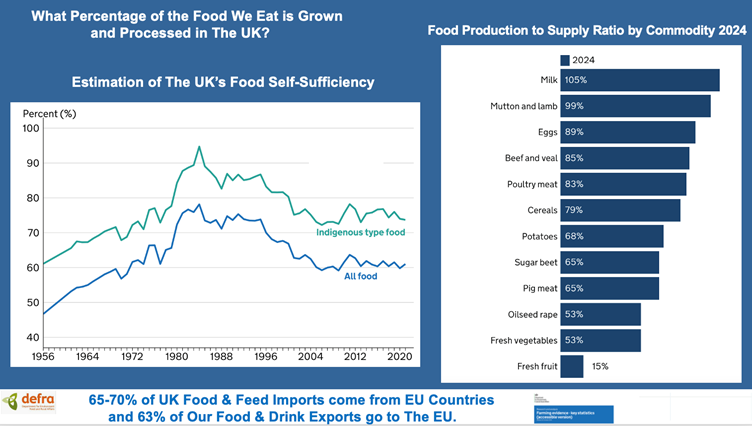
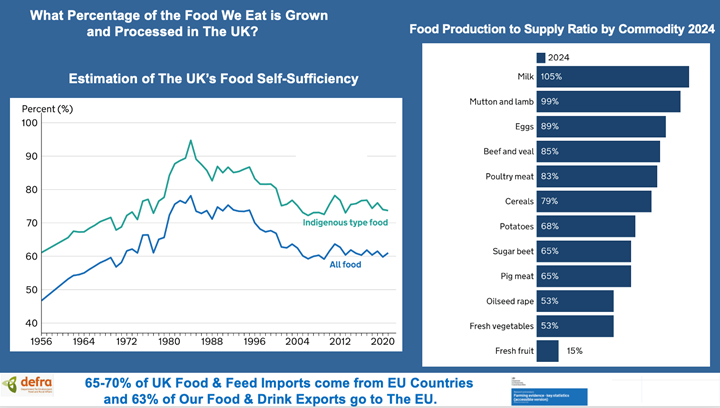
There’s been much talk in the UK and some action in response to producer concerns: such as strengthening The Grocery Supply Code of Practice (GSCOP) and establishing a statutory Food Security Index. Special attention has been given to producers of chicken, pork, eggs, fruits and vegetables.  Lidl is “investing £500m to bolster the British pork sector”, although likely the hard discount chain won’t be handing out bags of cash to its pig farmers. The recent government announcement at the 2024 Farm to Fork Summit of substantial support to food producers look parsimonious by comparison. However, horticulture did get special mention for assistance to raise our self-sufficiency in fruit from its lowly 17% level and our vegetable self-sufficiency up from its current 55%. Tesco has partnered with NatWest Bank to launch a discounted climate and sustainable farming finance scheme offering lower rates for regen.-type farming practices. Waitrose has a Dr. Dolittle “Pushmi-Pullyu” look about it: “for the good health of consumers, we’re slashing prices again on vegetables” which won’t translate into healthy margins for farmers, whilst it supports 2,000+ of its dairy, eggs and livestock farmer suppliers to transition to, initially, higher cost regenerative farming practices by 2035.  In time, food and farm input markets will stabilise and margins will recover to more acceptable levels (cold comfort for those businesses “collaterally damaged”).

Will the initiatives undertaken over the past couple of years provide protection for horticultural producers when the next price and/or climate crisis comes our way? Probably not! So, what’s the future-proofing strategy to put in place?

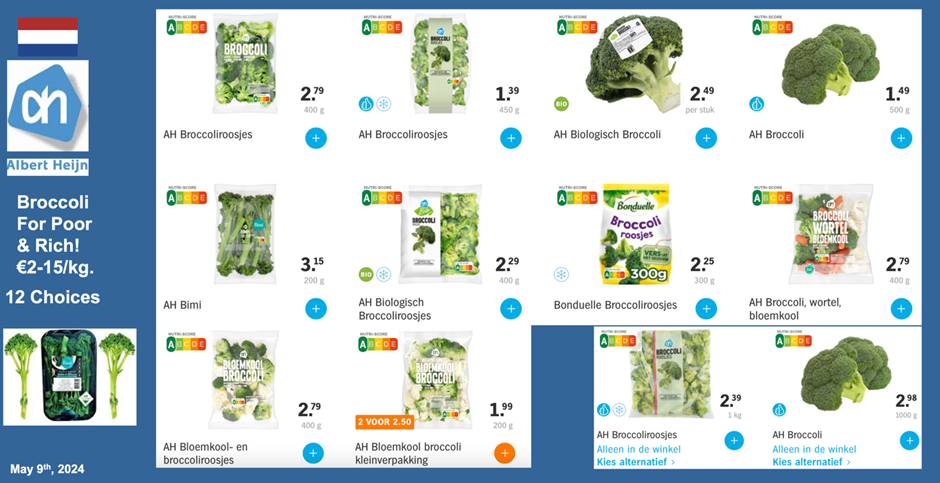
  1.  At a time when food consumers are (or, certainly, say they are) seeking foods that are good for the family’s health, then, fruit & vegetables should be supremely placed (in the box seat, as Aussies say). Look at the traffic light “nutri-scores” on produce sold via Dutch or French supermarkets – luminously green. Attributes relating to the heart, weight loss, gut and skin gain strong approval. Natural, “clean” ingredients catch the eye, not a worrisome screed of chemical names that are associated with Ultra Processed Foods (UPF). With very few exceptions, packaged fresh produce bafflingly makes no health claims at the retail shelf. Whilst packaging can still be used for fresh produce, stick the benefit on the pack and/or the shelf barker! Don’t assume the shopper will have the intrinsic benefits front-of-mind. Be assured, if a FMCG food or cosmetic product has the smallest sniff of a health/beauty benefit, it’ll shriek it from the rooftops (e.g. processed food products with blueberries as a minor ingredient will be slathered with antioxidant claims). Mimic processed products and, on the pack, state plainly: Ingredients: broccoli! Vegetable-based meals are on-trend. Not crap plant-based meats, but exciting/exotic main dishes using fresh (or frozen) vegetables. As a horticultural industry, we’ve just got to be way more on the front foot when communicating the intrinsic healthiness of our products.
  1. In the fresh produce aisles of stores and, particularly, on the web pages of online shopping, category presentations are, frequently, overwhelming. This is a retail issue over which supply chain members have little or no influence. In the fresh tomato category, there can be dozens of SKUs. Go in a store and watch bemused shoppers end up selecting the cheapest on offer because they can’t make out what are the benefits of the more expensive products and, be assured, they’ll not find any produce staff on hand with tomato nous. RedStar, the impressive Dutch tomato producer, reckon that 75% of in-store shoppers abandon their search and select the tomato product that is on offer and the lowest price. You’d think presenting category assortment online would be much easier but take a peek, it’s a nightmare. Tesco.com has 63 fresh potato SKUs over 3 web pages. If your product is on Page 3, likely you’re a goner! Most online shoppers never get past Page 1 (for sausages, there are 140 SKUs online and on 6 pages!).

Better definition and presentation of a category is in the best interests of all in the supply chain and it should be based on a profound understanding of consumer requirements and their emerging usage of the products in question – are the tomatoes for a regular or special meal, salad, sandwiches, snack, fancy garnish, or for cooking? Make it easy for the shopper to buy the “right” product for the “right” eating occasion.

  • Should packaging be banned on fresh produce to save the planet or allowed to save quality and shelf life? We really need to do both! It’s an international problem: leaving produce bare naked gives shoppers the opportunity to  embrace the full theatre of touching and smelling fresh fruit & vegetables but brings with it the real risk of damage to the produce and more waste. When David lived in the Caribbean, it was the bane of market fruiterers that shoppers would snap the tops off okra (lady’s fingers) to check that it was fresh  and, then, they’d discard the snapped ones to buy “perfect” produce. In our supermarket produce aisles, unwrapped avocados and stone fruit are pummelled to check for ripeness leaving bruised fruit for customers following! But, there’s a technological solution at hand. European retailers Jumbo  and Migros are trialling in-store scanners to check the ripeness of avocados. It’s working and driving sales!
  • Most fresh produce retailers in many countries offer the 3 tier range of “Good”, “Better” and “Best” products and they seek a select set of suppliers that can cover their 52-week supply needs. The “Good” part of the fruit and vegetable market has become increasingly commoditised. Bananas are the quintessential example: 99% of bananas exported are the Cavendish variety. In the UK, average retail price per kg. has clawed its way up from 83p in 2007 to 99p/kg. now.  Essentially, bananas have become a “free good”! There are brands (e.g. Chiquita, Dole, Fyffes) but, in fact, they’re not much more than sticky labels! The challenge for other fresh produce businesses is not to fall into the dreaded commodity trap. Yet, many “Good” (i.e. value aka cheap) fruit and vegetables are clearly straying into commodity territory – e.g. standard apples, grapes, root crops, brassicas. Long-term business survival as a “Good”/value supplier requires international cost competitiveness, scale, a track record of delivering the quantity and quality promised, a range of customers that may be in processing of premium and sub-retail standard produce, and a produce offer in higher margin “Better”, “Best”, and value-added.
  • For most produce suppliers, ownership of the intellectual property (IP) associated with premium (“Best”) produce is a step too far. Accumulating and owning varietal R&D is a long-term, expensive business. There’ll be a requirement to be a licensee working with a seed company and/or producing for a company that holds the seed license for a territory or country. For example, Japanese seed company Sakata owns the IP associated with a kale and broccoli hybrid. In the UK, it carries the brand name Tenderstem and is grown by a few, select growers.  In the EU it’s named Bimi, and in Australia Broccolini. Whatever the market, its retail price is 4-5 times that of bog standard (nonetheless delicious & healthy!) broccoli. Production costs are significantly higher than large-scale ranched broccoli but so are margins for these premium items. In the UK and EU, this branded product receives marketing support from Coregeo, a company that focuses on managing the branding of fresh produce. Coregeo won its spurs on developing the Pink Lady apple brand (note the huge price multiple that these apples earn versus Aldi-price matched apples in major supermarkets) and is building the Gem avocado brand for IP owner Wesfaliafruit.
  • Through the remainder of this decade and on, horticulture will see substantial consolidation as the technological revolution in the industry accelerates – gene-editing, robotics, AI, energy from solar/wind/biodigesters and more. Keeping up requires increasingly deep pockets and favours larger, better-resourced businesses. In Australia, half of the turnover of the fresh produce industry comes from just 11 companies, several of whom have received private equity financing in very recent years. Is the game up for smaller-scale businesses. Certainly not, but they better have a Plan B handy. Best start with an assessment of what is your business’s strengths and weaknesses. What’s your point of difference with the final consumer and with your customers? What do you bring to the party that’s unique (your USP, if you will)? Options could include:                                                                                         
    • niche marketing strategy and developing a local area brand;
    • keep well away from the big fruit & veg. commodity players who have the scale to exist on thin margins;
    • choose a minor product that has scale for you but not for the bigger players;
    • focus on developing close relationships with a single, significant customer in both the retail and food service sectors;
    • or, why not take a cold, hard, realistic view of future developments and decide whether this is time for a sale whilst there’s value in your business and take the money and run!
  • As a horticultural industry recognise that, jointly, we should raise our game. Nearer My God to Thee, for goodness’ sake, we’re in the health food game at a time when consumers are showing increasing interest in wanting to feel well physically and mentally not least younger ones. They want healthier families and increasingly recognise that healthy living means following a healthy, nutritious diet. In the UK, a change of government is imminent. “Saving the NHS” (state health service) will be near the top of the list of the newbie government. Here’s a huge opportunity to work in partnership with the health authorities to raise spend and consumption of the products we produce. Remember, in the UK, average weekly spend on fresh fruit & vegetables purchased from retailers is under £10 per household – that’s 4 cheap takeaway coffees! Onwards and upwards but remember, healthy food are important to consumers but they’re trumped by taste and convenience. Our industry motto: “We’re The Leaders in the Tasty, Convenient, Healthy Food Game”!
Tagged with: , ,
Posted in Fresh Products

Tough Times for Food Producers: Balmy Commercial Times to Come?

The business of producing food has never been a piece of cake (apart from growing cress on a damp kitchen towel), particularly for farmers. It’s extraordinarily challenging when tragic wars are bringing upward pressure on the costs and even availability of key inputs, such as energy, fertiliser, feed costs and ocean freight transport (only the most perspicacious business planner would’ve put simultaneous problems in The Red Sea and The Panama Canal down on the “must watch as immediate risks to my business” list). Then, there’s the excruciating double whammy of a wet and warm El Niño period exacerbating the advance of the frightening global climate change era (N.B. era not period). To make things even worse, some governments have taken the moment to implement agricultural policies (well-intentioned but, arguably, ill-timed and/or inept) to address a plethora of issues such as: across the EU and the UK, legions of farmers squeezed by economic pressures and outraged by perceived over-regulation largely relating to environmental policy, feeling let down by free-trade agreements, and the threat of the removal of subsidy on farm fuels. In David’s “home country” Wales, farmers have been incandescent over The Welsh Government’s proposed policy to require farmers to bring their existing tree and woodland cover up to 10% of their total farm acreage, as have Dutch dairy farmers threatened by their government wanting to “force purchase” farms to reduce the nitrogen pollution impact of intensive livestock production. Welsh farmers made their point by placing thousands of pairs of wellington boots (“wellies”) on the steps of The Welsh Parliament, whereas EU farmers showed how effective a few hundred tractors blocking the roads to large cities can create traffic chaos.

Currently, there’s not a lot of happiness about! Food consumers aren’t over the moon. Food prices rose by only around 2% between May 2023 and March 2024, hurrah! But food prices rose 22% between March 2022 and May 2023. So, consumers have seen their food bills rise by close to 25% since the pre-Covid period, whilst many farmers have seen their net incomes ravaged. Those at the beginning and the end of the food chain blame those in the middle. It was ever thus in a cost-of-living crisis! “Big Food” takes the rap – i.e. large supermarket chains and the mega-branded international food processing companies. One manifestation of the rap is the launch of government enquiries into profitability in the food system with the intent of identifying villains. There’re dozens of such enquiries about, not least in countries where a few supermarket chains (e.g. 2 in each of Australia and New Zealand) have a huge, combined grocery market share. The findings? In competitive grocery markets which are in a notable food price inflation period, supermarket chains are not shown to be iniquitous profiteers. Oh, boo! In the UK, the Competition & Markets Authority (CMA) report that aggregate operating profit for the retailers’ grocery businesses between FY2019/20 and 2022/23 declined from around 3.3% to 1.9%. It may be reassuring for financially literate consumers that their grocer makes less than 2p in the £ profit but it’s cold comfort for a supplier to that grocer who’s been squeezed into supplying the grocer at a loss such that the supermarket chain can be competitive with an on-the-loose hard discounter! There’s been a lot of that about. Mind you, for those in the food industry, for our final customers, buying food isn’t an option, it’s a prerequisite for the life of the family. You can put off buying the new sofa but, one way or another, you’ll have to acquire food.

It can be tough for one and all in a difficult inflationary period and excruciating for some! Low-income consumers, for a start. Household income polarisation in the UK (and, to a lesser extent, in the USA) has increased over the past 50 years or so. Rampant food price inflation hurts poor households – the lowest income households in the USA spend 30+% of income on food (say $6,000/p.a. total), whereas the top group spend 5% of income on food (say $17,000) – the percentage figures are not dissimilar in the UK. It’s a salutary reminder that there are “income haves” and “income have nots” and, also, explains why premium retailers such as Marks & Spencer (M&S) and Waitrose in the UK and Whole Foods Market in the USA (aka “Whole Paycheck”) can bob along comfortably in a cost-of-living crisis even as hard discounters like Aldi and Lidl (Aldi is the fastest growing grocery chain in the USA) nip market share from middle-of-the-market chains. In the UK, “Which” Consumer Choice magazine’s 2024 survey of customer satisfaction with grocers shows M&S and Aldi in the top 2 positions and Asda and Morrisons in the bottom 2.

Big and small branded food companies have had their challenges as shoppers have leaned more to purchasing private label products. Smaller brands have struggled to get on retail shelves as grocers trim their ranges to increase efficiency. “Shrinkflation”, i.e. reducing the size of a product whilst maintaining the same price, has become pervasive not least in confectionery. International cocoa prices have tripled over the past 3 years and our favourite choccy bars have quietly lost weight! Don’t forget food service, too – many consumers are eating out less or focussing on value meals which, in themselves, may have shrunk in size (e.g. there’s fewer Burger King chicken nuggets in a box than pre-2022). Are consumers giving up treats to save their money? NO – in a stressful world, many want “delightful distractions” and one trick is to include in the ingredient list for your product an item which has a guilt-removal health halo – “oh, look, it’s got those blueberries bursting with antioxidants in it (<1%)”!

Back at the farm level, fresh food producers – meat, eggs, dairy, fruit & vegetables – have had a particularly torrid time this past 3 years. Fresh foods are the competitive standards for grocery retailers and mainline supermarkets price matching hard discounters is ubiquitous. It’s galling for fresh produce growers to read that “In time for Easter, (hard discounter) Aldi Lowers Pricing on 7 Staple Vegetables To Just 15p Each” and premium retailer Waitrose “Commits To Good Health by Slashing Prices Again On Fresh Vegetables” – particularly so because most of the principal retailers aren’t backward in coming forward to advise food shoppers that they have close commercial relationships with their “farmer partners”! Normally circumspect in criticising their major customers, UK grower groups have shrieked foul play leading to a “Farm to Fork Summit” back in May 2023 in the UK, a Senate Select Committee Enquiry on Supermarket Prices in Australia (February 2024) with AUSVEG calling for action to secure fair prices for suppliers and there’s been similar calls for regulatory action across The Tasman Sea in New Zealand. Farm groups seek strengthening of instruments such as the UK’s Groceries Supply Code of Practice (GSCOP). The fact of the matter is that improved GSCOPs are useful for improving suppliers’ bargaining position with major customers but additional action by food producing business is required. This will be for discussion in our next mini blog! For fruit & vegetable producers, the double whammy has been that, in the cost-of-living crisis, consumers in the UK, EU, USA, Australia (amongst others) have reduced their fresh produce purchases to conserve dwindling real household income.

In the UK, a combination of some poultry/egg/meat/horticultural farmers stopping production because of, inter alia, negative margins (e.g. cucumber growers not planting at a loss because of escalating energy costs, import competition, and sticky retail prices), escalating input prices for feed (well, for everything!), and extreme weather conditions (e.g. a super abnormally wet and warm 2023/24 Winter), have led to the unwelcome sight of empty shelves in grocery stores. Back in November 2022, most of the major UK grocers rationed egg purchases. In mid-April, tomatoes are few and far between on UK retail shelves because of extreme weather conditions in our out-of-season source countries of Spain and Morocco. This has focussed attention on whether the UK nation is sufficiently food secure (and, concomitantly, farm input secure for energy, CO2, fertiliser, etc.).

Give or take, the UK is about 60% self-sufficient in food, and 75% self-sufficient in “indigenous” food (i.e. the food we can grow in the UK as we’re poor at growing bananas!). In history, we’ve been at 100% (pre-1750’s), under 40% (early-1950s) and up to 65% (mid-1980s). The level of sufficiency is, largely, a function of government price support and trade protection for agriculture (e.g. deficiency payments to farmers in the 1950s, followed on by EU payments from 1973). In February 2024, our Prime Minister announced the establishment of a Food Security Index reflecting the nation’s concern about food availability in an uncertain world threatened by global political instability and climate change. Whether this translates into additional protection for UK food producers it’s too soon to say. Politicians of any stripe must balance the interests of domestic food producers and consumer voter food budgets. But, in a global warming world and the rapid advancement of high tech horticulture (e.g. advanced hydroponics and vertical farming), we’d be surprised if the current low level of UK self-sufficiency for vegetables – 53% – and very low level for fruit – 16% – doesn’t increase substantially through time.

So, once we’ve sorted current supply chain problems and the cost-of-living crisis recedes will it be balmy times for UK and, indeed, global agriculture? After all, the farmers of the world should be on a pedestal: in 1954, the global population was 2.7bn and most were fed; by 2024, our world population is 8.1bn and most of them are fed …. by farmers using the same, even less land than in 1954. Astonishing! But, this Herculean agronomic effort has come with adverse consequences that are contributing to climate change and biodiversity loss. We can see this locally (e.g. David lives by the River Wye polluted by agricultural runoff) and internationally (the Amazon region lost a rain forest area 3 times the size of the UK between 1985 and 2021).

We know the size of the climate change problem and the consequences of inaction. Wise Benjamin Franklin opined “Don’t put off ‘til tomorrow what you can do today”. What’s more, through the series of UN Climate Change Conferences (the COPs), responsible (most) nations have already made promises/commitments on limiting the global temperature increase to 1.5C above pre-industrial levels, and 16 other world sustainable development goals (UN SDGs). We’re way behind delivering on our promises. In COP28 (Dubai, Nov/Dec 2023), however, most countries signed up to a “Declaration on sustainable agriculture, resilient food systems, and climate action”. So what? Just UN yabbidy yah? Our children/grandchildren won’t thank or forgive us if we sit on our thumbs. In the next 2 COPs (late-2024 and late-2025), we’ve committed to move from vision to firm action plan on agriculture and food by the end of 2025 with targets such as: cutting greenhouse gas emissions by 25% and halving N2O and CH4 emissions from agri-food systems compared to 2020; and ensuring global agri-food systems are net carbon sinks by 2050. None of this is easy but, what is certain is that farmers of our world must be in the vanguard driving change in how we produce food for our growing world. This isn’t agri-politics, it’s a fundamental requirement for the continuing existence of our planet! We’ve got to change our food production practices and, likely, our diets. There’s no messing with the forces of nature and let’s give polar bears bigger beds!

David Hughes and Miguel Flavián

April 19th, 2024

Tagged with: , , , ,
Posted in General, Sustainability

Farmers are Revolting: What’s It All About and to What Avail?

Farmers are often grumpy. It’s the unpredictable elements of their business such as tussling with the vagaries of the weather, market prices, awkward customers and regulators, and coping with the peccadillos of their neighbours and wayward countryside visitors. But, right now, they’re angry even furious all around the world. In India, farmers are marching on Delhi. Across Europe, capital cities are under siege. What’s it all about?

In history, whenever we have consumer food prices spiking, we look for the villain. The first port of call is generally the supermarkets, followed by the big, branded food processors. Global food commodity prices peaked at record levels in March 2022 but it took a few months for these elevated commodity prices to work their way through to higher prices at retail. In the UK, food price inflation spiralled up to just under 20% (year-on-year) by March 2023. Since then, the rate of food price inflation has declined every month to a “modest” 7% in January 2024 – a level that would have been labelled “Shock, Horror” by the tabloids in the balmy pre-pandemic period. So, if food commodity prices were burgeoning, why would farmers be revolting? Well, commodity prices have declined by 25+% since their giddy heights and, concomitantly, key farm input prices (e.g. fertiliser, energy, finance, herbicides, seeds, etc.) have come off their highest levels but remain well above those that were the norm prior to the calamitous past four years! This has resulted in severely squeezed margins for many farmers.

In terms of angry farmer responses, who’re the most revolting? We’d put Indian and European (EU) farmers in the top spots, normally conservative New Zealand cockies in bronze medal position, Scottish and Welsh farmers mid-table (outraged about policies directed at non-food use of their land), with English farmers lower down the angry league table being a more circumspective “jolly cross”!:

  • close to 60% of India’s 1.4bn population rely on agriculture for their livelihood. There are 120+ million farmers and 85% of them sit on tiny pockets of land. Heavy duty policing has stopped thousands of farmers marching on Delhi (as they did in 2021 and they stayed there for an entire year) but, likely, their progress to the capital is far from over as farmer leaders have just rejected a government proposal to buy selected crops – pulses, maize, cotton – at assured prices on a 5-year contract. The farmers are hell bent on gaining a similar deal for all of their crops;
  • farmers across Europe have taken to the streets in Poland, Czech Republic, France, Germany, Spain and Italy to fight low prices and high costs, cheap imports exacerbated by Autonomous Trade Measures (ATMs) introduced to give Ukrainian cereals and oilseeds access to export markets via the EU, and EU climate change constraints (e.g. EU Green Deal). The EU Commission’s response to this farmer pressure has been to dilute its climate change goals – e.g. the EU 2040 Climate Target no longer mentions a 30% cut in non-CO2 emissions from agriculture, such as methane emissions from livestock and nitrous oxide emissions from soils;
  • in New Zealand, livestock farmers united to dismantle the incumbent Labour party’s climate policies and, with infuriated urbanites, contributed to the Labour Party’s ejection and a significant political move to the right in the October 2023 election;  
  • in the UK, Rishi Sunak became the first British Prime Minister in 15 years to address the National Farmers Union Conference offering £220m ($275m) to put into new food productivity schemes focussing on farm technology and automation to reduce reliance on overseas workers. He proffered plans to reduce red tape and make it easier for farmers to diversify their businesses. Farm to Fork annual food security summits have been promised and he assured farmers of milk, pigs, eggs, chicken and fresh produce that regulations would be introduced to ensure fairer contracts for them with their major customers, particularly those iniquitous supermarkets.

Is this democracy in action – caring governments listening to much respected rural members of the electorate and providing solutions to farmer problems? Maybe but it’s worth noting that India, the European Parliament, and The UK all have key elections in the next few months raising the likelihood of government leaders responding sympathetically to the rural vote! The UK Government response is welcome but not of the same order of that emerging in India and the EU where firmly held principles – in India on accelerating structural change in farming, and in the EU on its much-vaunted Green Deal – are being/will be sacrificed to mollify angry voters. It was ever thus – the squeaky wheels get the grease!

Elections will be held, some governments will change, farm input and food output markets may stabilise in the short-term as we judder our way through the remainder of this decade. However, the global picture is far from being a haven of tranquillity and it’s most unlikely that the international food commodity price pattern which followed that of the August 1973 price peak (the nearest equivalent to our most recent March 2022 one) will be repeated. Back in 1973, analysts opined that the price peak would usher in much higher food price levels than in the past. In fact, over the next 30+ years (1973-2005), international food prices trended downwards (a halcyon period for food consumers), as global food supply flourished through farmers improving management techniques and increasing the use of fertiliser, improved hybrid seeds and herbicides. 

Over the next 30+ years from our most recent 2022 price peak, international food commodity prices will be substantially more volatile than in the past. Overwhelmingly, commodity price instability will reflect some combination of increasingly extreme “climate events”, oil & gas price spikes not least linked to international political instability, government biofuel policies as green target dates come closer and domestic “energy security” concerns rise (note the recent impact of India’s domestic biofuel policies on the world sugar market), and disruptive changes in national food exporting policies – such as India’s ban on selected rice exports and Turkey’s ban on bulk olive oil exports. From a farmer perspective, this will require substantial resilience, traditionally, a farmer strong suit, but also, the technical and financial capacity of farm businesses to incorporate the new technologies that will be central to profitable green farming in the 2030s such that we can produce more food with less impact on the health of our planet.

A graph showing the price of food

Description automatically generated

Will the angry exchanges between farmers and their governments continue through the remainder of this decade? Very likely, YES! Under the auspices of the United Nations, most governments have signed up to the target of reaching “Net Zero by 2050”. In COP28, completed in December 2023, a global roadmap given the thumbs up by 130+ countries was released by FAO showing the pathway for global agriculture and food to make its contribution to achieving Net Zero without allowing global temperatures to exceed 1.5C above pre-industrial levels. Yet the EU has stumbled at the first hurdle by diluting its climate change goals, notwithstanding that the EU has already signed up to cutting gross GHG emissions from agri-food systems by 25% by 2030 and to be CO2 neutral and make significant cuts in nitrous oxide and methane emissionsby 2035. You can see 2035 from here! It’s not as if EU farmers are being asked to support these green initiatives for nothing. After all, one-third of the massive EU annual budget goes to farmers, most in the form of direct farm subsidies. Looking at the farm support schemes in the EU (and the UK for that matter), Kiwi farmers must be shaking their heads as they “celebrate” the 40thanniversary of the subsidy rug being pulled from under their feet. New Zealand is a signee to the UN (FAO) Global Climate Change Road Map and the promises it has made will be delivered by its farmers largely off their own backs.

One of our principal reflections on the recent flurry and expected continuing angry exchanges between farmers and their governments is that it is indicative of lack of collaboration. High profile international events such as the COPs leading to reassuring pronouncements on a better future for our planet are more likely to be successful if they are based on firm agreement with those who must deliver the promises made, i.e. those that actually farm the land or ocean! Finally, the above views on farmer anger do not cover those producing fresh foods for sale principally via supermarkets. That’s another story and, very shortly, we’ll offer a few thoughts on this contentious topic.  

Tagged with: , ,
Posted in General, Sustainability

A Brief Look at Agricultural & Food in the USA and Some Thoughts on the Impact of an FTA with the USA

The USA is a Big Beast in geographic size, population and economic and political clout. Back in 2020, spurred by the Conservative Government’s desire to be seen as a nimble, swashbuckling free trader unencumbered by sclerotic EU bureaucracy, negotiations were started to establish an FTA (Free Trade Agreement) with the USA. Progress stalled, like many trade negotiations, but it’s mooted that the President/PM of the respective nations are determined to have something on paper before the upcoming elections. After all, the USA and UK are significant trade partners – USA exports to UK are around $77bn and UK exports to USA are $65bn. In history, food and drink trade between the two countries has been modest: the lion’s share of UK exports being Scotch whisky, then, other spirits, beer and salmon; with wine, tree nuts (e.g. almonds), and bakery goods leading the charge from the USA. Yet, the UK agricultural sector is hugely apprehensive of an FTA which includes comprehensive coverage of food items from the USA. The apprehension has been fuelled by the swift FTA trade deals that, to the fury of UK livestock farmers, were swished into place between the UK and Australia (2021) and New Zealand (2022) and the expectation that we may well complete agreement to join the CPTPP, an Asia-Pacific trade bloc, in the latter half of this year. It’s a good time to peek at the USA from a farming and food perspective just in case normally glacial trade negotiations grow some wings! Whilst the UK has “a special relationship with the USA”, it’s propitious to keep in mind that our prospective free trade dance partner is elephantine so watch your toes! Attached is a series of slides that give the detail of the following commentary.

Give or take, the USA has a zero-trade balance on agricultural trade – exporting around $200bn and importing roughly the same, whereas UK has a significant trade deficit on agricultural, food and drink – we export $31bn, with whisky and salmon from Scotland in top spots, importing $73bn, not least fruit and vegetables from Europe. American agri-food exports are dominated by 4 categories – grains and feed, oilseeds and their products, fresh produce (large exports of fruit and vegetables to Canada in the colder seasons), and meat (principally, beef largely destined to Japan/S. Korea and other Asian markets and pork). The key agri-food export destinations are China, Mexico, Canada, Japan and (lesser so) the EU. These same 4 categories dominate agri-food imports to the US, with horticultural produce the largest (e.g. fresh produce from Mexico counter-seasonally).  The US is a substantial meat importer – beef from Canada and New Zealand, sheep meat from Australia, pork from Canada.

What about the USA food production sector – are all farms Texan size?! Average farm size is 180ha (450 acres) more than double the average English farm size.  The US has 2 million farms on 364m ha. (we’ve got 200,000 or so on 17.2m ha). “Small” family farms (gross cash farm income <$350K, i.e. £275K) comprise 89% of all farms but account for only 18% of production value. The large family farms and corporate farms account for 5% of farm numbers but 63% of production value. Many of the “small guys” are essentially hobby farmers and much of their income comes from off-farm sources. Corn and soybeans dominate grains and oilseeds production with an 87% share of land. 90% of soybeans are used for livestock feed, whereas 45% of corn is used for livestock feed, 44% for ethanol production and 10% for human food (with a third of this being converted into HFCS). In stark contrast to the UK, more than half of US cropland is sown with GM seed: essentially, all the area for corn, soybeans, cotton, canola, and sugar beet.

As an aside, the US crop seed sector has undergone significant structural change, spurred by the expansion of intellectual property (IP) rights and heavy-duty investment in R&D by the major seed companies. Bayer and Corteva GM seed accounts for 72% of planted corn area and 66% of planted soybean area in the US, in addition Syngenta is a significant but “minor” player. The “Big Four” (the latter 3 plus BASF) invest around 10% of their seed and agrochemical sales value on R&D to deliver improved yields for farmers and secure, profitable IP for themselves! Between 1990 and 2020, prices paid by farmers for “generic” crop seed increased by around 170%, and IP-protected GM seed prices rose by 463% – compared with a 56% increase in crop commodity prices over this period.

Apropos concentration in the crop seed market, a similar picture emerges in meatpacking industry in the US: 4 firms, Tyson, Cargill, and 2 Brazilian firms JBS and Marfrig account for 85% of beef processing; WH Group (Chinese-owned), JBS and Hormel account for 67% of the hog/pork processing sector; and JBS and Tyson account for 45% of chicken processing. Concentration in these sectors is high and has been rising. The names of the major players are not unfamiliar to livestock and meat participants in the UK and elsewhere! Encouragingly, in the USA, rising meat price spreads/packer profits is attracting new entrants into the meat processing industry providing livestock producers with more selling options than simply the “Big Boys”.

What of the USDA’s view on future production and prices for crops and livestock through the remainder of this decade? Corn and soybean production and exports are expected to show strong growth and exceed record levels, whilst crop prices are projected to decline in the next 3 years and then generally stabilise. This isn’t great news for crop farmers as margins will be under pressure. Whilst global fertiliser prices returned to 2021 levels in later months of 2023 after surging in 2022, their 2024 and expected future levels are still substantially above those of early-2021 and all other farm input prices are at historic highs. Fertiliser “security of supply” continues to be of concern with Russia and China accounting for 25% of global fertiliser trade. Production and exports of beef, chicken and pork are projected to increase over the next 10 years. Beef and chicken prices are projected to remain elevated while hog/pig prices are forecasted to fall.

Who gets what from the “Food Dollar” in the USA? Roughly one-third (34%) goes to food services – in the US, over 50% of consumer spend on food is “away from home”, whereas this figure is around 40% in UK. Food processors take 14% of the food dollar, whilst 12% goes to the food retailer and the wholesaler takes 11%, with the beleaguered farmer, the producer of the raw ingredients, taking a lowly 8%. Just as in the UK, consumer household income has become increasingly polarised in the USA: families in the lowest income 20% spent $5,000 on food ($100/wk) in 2022 accounting for a good third of their annual income. The well-heeled in the top 20% of income spent close to $16,000 on food for the year ($300/wk) accounting for around 7% of their household income. For low income households , there is substantial income assistance for food from the state: in 2023, this was close to $150bn – most via SNAP, the Supplemental Nutrition Program, supported by Child Nutrition Programs and WIC, the Women, Infants and Children Program.

A short note on meat – Americans are notably carnivorous! The figures presented are for boneless, retail weight meat and, excuse us, are in lbs! For the past 50 years, per capita beef consumption has wended its way down from close to 90lbs to near 50lbs in the early 20teens but has recovered of late to closer to the mid-50slbs. For 75 years, pork and its products has meandered around the 50lb mark. Like in many countries, chicken has been the meat industry disruptor reaching near 70lbs of late. Over the last 50 years, fish consumption has slowly increased to its current level of 20lbs per capita. What about veg.? Through the past 20+ years overall per capita consumption has trended downwards. Starchy vegetables, particularly potatoes, are of huge importance albeit slowly declining year-on-year and processed potatoes (frozen predominately) continue to replace fresh. Fresh and processed tomatoes have maintained their prominent position, and “other red” and orange veg. (e.g. red & orange peppers, carrots) have seen consumption growth, as has pulse consumption (chickpeas, lentils, peas, beans), particularly in more recent years.

A last word on food consumption, Americans are eating too much and, often, with unhealthy diets. The adult obesity rate is 42%. It’s lower for children but increasing at an alarming rate. Very recent research identifies that average proportion of calories from protein in the American diet decreased from 14% in 1961 to 12.5% in 2000 with more calories from fats and carbohydrates making up the difference. For sure, they didn’t eat less meat. Many reached too frequently for the snack box and over-ate addictively moreish food products that, most recently, have been labelled Ultra Processed Food (UPF). Americans are not alone! The obesity crisis is global with terrifying consequences for global consumer health, pressure on medical services and global productivity and economic growth.

Enough already! The previous thoughts are provided to give the reader an overview of some aspects of food production and consumption in the USA. In this final brief section, we’ll look at what the implications might be for UK farming and its food industry if an FTA was agreed between the 2 countries. Might this happen in 2024? The PM and President of the 2 countries both need quick wins in this election year and, to use NFL parlance, could elect to use a “Hurry-Up Offense” approach to trade negotiations. Would this bring opportunities or threats for UK agri-food & drink?

First, let’s be positive! The USA is a big, rich country with plenty of high-income consumers who know and like us. They’re gaga about our Royal Family and historic buildings, and assume we largely dine on fish & chips. The Scots would be ecstatic, and exports of whisky and salmon would soar in a tariff-free market. There are considerable opportunities for our specialty cheeses, pork and lamb.

The big negatives for the UK in a US trade deal relate to concerns about “low standards” in the USA regarding animal welfare, the environment and more contentiously, food safety (e.g. the emotive American chlorinated chicken issue). From a UK farmer perspective, the rub is that being in the van on welfare and the environment brings additional production costs and it’s simply unfair if competitors can enter our market without matching our mandatory regulated standards. These concerns – being on the cutting edge on green issues but, also, on “the bleeding edge” – are shared by EU farmers.

Animal welfare regulation in the USA is complex and slow (relative to the UK). There’s no national policy relating to farm animals as it’s a state responsibility with 14 out of the 50 states already started on the welfare journey. Liberal California is way ahead with cage-free eggs and veal and a ban on sow gestation crates already in place. As of now, the UK pork sector has a “gateway” into the Californian pork market with the state’s Proposition 12 certification (via NSF). Animal welfare regulations and some agri-food businesses are moving albeit slowly in a direction we’ve long embraced in the UK: e.g. by 2026, 17% of breeding sows will be gestation crate-free; and McDonald’s has met its cage-free pledge on eggs this February, some 2 years ahead of its initial plan. Beef produced with anabolic hormones will be a trickier trade issue as 90% of beef cattle produced on USA feed lots have such implants. The biggest barrier to “hormone beef” imports into the UK is that our shoppers are vehemently antagonistic to such! Although, in the unlikely event that a trade deal gave such beef the all-clear, it could be squirreled into the lower end of the food service market where product transparency and labelling are less in evidence.

Environmental considerations relating to agricultural production will be integral elements in any future global trade agreements and should be included, albeit contentiously from a USA perspective in an FTA with UK. Take note of EU farmers demonstrating against the pace of introduction of The European Green Deal. Just imagine the UK farmer reaction if, in a trade agreement, the partner was given carte blanche to use practices and products banned on their farms – they’d be incandescent with rage! The direction of travel on environmental constraints to those importing products into the EU is clear: EU Deforestation Regulations require companies trading in cattle, cocoa, soya, oil palm, coffee and wood to prove that their production did not result in deforestation. The UK is on the same track and if, for example, some pesticides are banned on specific crops it would be hugely controversial if farmers in trade partner countries were allowed to use them on products which end up in our own country. Right now this is a huge issue. The UK is a significant food importer. Indeed, the land used “offshore” to produce the food we import is close to the same area that we produce food on at home! We can’t be holier than thou at home if we are exporting environmental problems to our trade partners supplying us with our food!

Completing an UK-USA FTA in this calendar year would be a Herculean task and one not supported by many in UK agriculture. If it came to pass, would our food market be swamped with American fare, and would it be a halcyon period for UK food exporters? No! Apart from anything else, building a market presence with new customers takes time. Most likely, the current pattern of trade between the two countries would continue but in greater volumes and values. Finally, through the past few turbulent years, concerns about national food security have been increasingly evident. Likely, our political masters, enthusiastically encouraged by UK farmers, will be more focussed on increasing food production at home than on forging international food partnerships.

For those fond of stats. related to the above, click on the following link:

USAAgriFoodStats2024.pdf

Tagged with: , , ,
Posted in General

Are We Out of the Woods Yet? Looking Back & Forwards with Some Thoughts for Farmers.

This week, I’m giving a talk to The Monmouthshire Agricultural Club in Usk – I’m “a local”, living 12 miles down the road in Monmouth. Here’s the gist of what I had to say. Do flick through these few pages and, then, if you’re of a mind, click on this link to look at the slides I used in my presentation.

Click here to download the presentation.

Henry Dimbleby’s National Food Strategy Plan has a lovely representative map of how land is used in the UK. We’re good at growing grass – 60% or so is down to pasture for cows, cattle and sheep. We’ve got a good lump of peatlands and broadleaf & conifer woods. Our fruit and vegetable area (not including potatoes) isn’t much bigger than our acreage for golf courses. The built-up area is close to the size of Wales! Intriguingly, the overseas land used to produce animal and human food for the UK is close to the size of the area we use for domestic food production in the UK.

Global food commodity prices peaked in March 2022 and have declined month by month since then, although they’re still historically high and at the elevated levels we saw in 2008 and 2012. These took time to pass through the supply chain and consumer food price inflation peaked at close to 20% in April 2023, exacerbated by the Russian second invasion of Ukraine in February 2022. Come 2024 year end, food price inflation should be down to 2% or so but, remember, prices are continuing to inflate and not returning to the halcyon stable times between 2015 and 2019. The cost-of-living crisis remains with us and explains the ferocious grocery retail price wars fuelled by hard discounter continued store expansion. Are supermarkets the villains? Well, they may be for mauling fresh food suppliers but their operating margins have been under pressure, too (less than 2% in FY 2022/23).

But, hey chill out! The pandemic is over (fingers crossed). The Russia-Ukraine war (our war, too) is limping towards stalemate. Tranquil times are coming …… apart from: the tragic mess in the Middle East; international trade routes under threat in the Red Sea/Suez Canal and the Panama Canal; frightening evidence of the acceleration in planet-harming climate change; and half the world’s population are having national elections this year which is leading to a frenzy of mis/disinformation, a lurch to political extremes and added uncertainty for businesses worldwide. In the midst of this, food producers are being asked to accelerate their farming activities to meet challenging net zero targets. In the EU, farmers are revolting and have bent the ear of government. In the UK, we’re being very British about it and we’re jolly cross!

Empty supermarket shelves through the recent turbulent years have fuelled concerns both about food self-sufficiency (60% for all food and 73% for indigenous type food) and, separately, food security at the national and individual household levels. Food self-sufficiency levels in the UK (and elsewhere) are hugely influenced by government policy: close to 100% prior to 1846; with the repeal of “The Corn Laws”, a downward swing to 35% in the early 1950s reflecting the extended period when we in the UK produced the machine goods and our colonial compatriots produced most of our food; the near catastrophe of the 2nd World War years where we close to starved; a recovery of food self-sufficiency after the introduction of deficiency payments emanating from the 1948 Agricultural Act; boosted further as we joined the EEC; and, latterly, drifting down to current levels as we exited the EU in the 2020s.

As an aside, our lowest area of food self-sufficiency relates to fresh produce. Whilst partly explained by consumer preferences and climate (26% of ALL fresh fruit consumption in the UK is accounted for by bananas), we produce only 16% of fresh fruit and only just over 50% of fresh vegetables consumed in the UK. The emergence of advanced hydroponics and vertical farming could and, indeed, should, switch these percentages to our advantage over the next few years. However, what consumers value is changing. Fresh fruit is struggling in the market against “real” fruit-based processed products such as smoothies, dairy-based fruit drinks and the like. Similarly, there’s a host of “real” vegetable-based snacks with “clean” ingredient labels nudging fresh vegetable dishes off the table. Across Europe, and in North America, per capita consumption of fresh fruit and vegetables has declined through the recent turbulent years. The clothes of the fresh fruit and vegetable sectors have been stolen by fmcg snacking companies and the cosmetic and natural pharmaceutical industry. Have a peek in Boots, it’s a fruit & vegetable extract pharmacy!

Notwithstanding our exit from the EU, most of our food imports come from Europe which is where most of our food exports go to. Us Brits respect our home farmers but our commitment to purchasing home grown is much less than Italian consumers who have a much stronger food culture wrapped around local foods with strong heritage and stories. Our appetite for imported foods shouldn’t surprise us – we’ve been doing it for centuries (e.g. bacon from Denmark and lamb from New Zealand). What’s more, the vision of a swashbuckling Britain freewheeling our trade way around the world is reflected in post-Brexit trade deals with Australasian friends and more and is unlikely to drive food self-sufficiency at home!

With some trepidation, here’s some commentary on farmers’ incomes in the UK. Bonanza years apart (e.g. for some cereal and oilseed producers in 2022), for most farmers, income from agricultural activity per se is less and, for a whole slew substantially less than income earned through other sources such as basic payment schemes, environmental payments and non-farming business activities. Some agricultural input prices (e.g. fertiliser) have declined but are still well above pre-Ukrainian invasion levels. Farmer margins are not set for significant growth. Net agricultural income from lowland and LFA farms is virtually zero and farming income for many largely comes from the public purse and non-farming activities. Yet, direct income support from Government programmes has been and will very likely continue to decline. Like the cavalry, ELMS/SFI monies (payment to farmers for providing “green” public goods on-farm) are slowly arriving, if one has the intestinal fortitude to navigate the 200+ page rule book that is a precursor for accessing “green” grants. One distressing outcome of this squeeze on farm income has been a sharp jump in emotional problems on the farm. FCN report worrisome escalations in financial and mental wellbeing calls for help.

A word or two on diversification on the farm. English data shows that close to 70% of farms undertake non-agricultural diversification, up from 50% 15 years ago. Most of such diversifications are “other than letting buildings” (e.g. to customers seeking to rent storage space) This is no surprise to me. Thirty plus years ago, I started teaching on the annual Worshipful Company of Farmers Advanced Farm Management course. In 1990, each participant would introduce themselves and it took a minute or less: “Elwyn Hughes, dairy farmer from Carmarthenshire” – job done. Now, it’s a veritable lecture verging on homily: “John/Jill Lomax, broad acre farmer from Lincolnshire, equestrian events, weddings, yurt glamping, gin distillery, rare breed zoo, pumpkin sculpting, drone displays & training, etc.!”.

For many farmers, the non-farming diversification element of family income is only going to grow – for farm businesses operating at smaller to large-scale. The topic is vast and not to be waved through in a paragraph squirreled within a blog. For some, diversification will be gaining leverage from the farm’s intrinsic advantages with investment that reflects the reality of sparse family finances. For others, with greater access to capital, grander and riskier “value-adding” schemes may be on the cards. Two on-farm gin examples come to mind: the first, Tipplemill London Dry Gin from a family farm in South Lincolnshire and the second, intriguingly, Wa-Gyn from a Yorkshire Wagyu beef business where the gin is washed for 48 hours with molten Wagyu fat (see pics. In the slide presentation)!

In the UK, we have the advantage (albeit sometimes a disadvantage for those who’ve had machinery stolen/animals harmed/crops flattened, etc.) that we farm in countryside which is close to the urban population. What’s more city folk relish visiting rural areas. They like many of the products and experiential services we can offer them. They’re on our doorstep whereas, in North America, farms are somewhere “Out West”! Mind you, it requires a substantially different set of skills to deal directly with customers, not least from the general public, arriving with a rural idyllic view of the countryside, than the many and varied skills required to run a farm growing produce for less personal commodity markets. For the agricultural producer tentative about non-farming diversifications, perhaps leave such enterprises for the generation beneath or the one by your side. Only partly with tongue in cheek, I know that there’s many a dyed in the wool farmer who should never meet a food consumer or tourist face-to-face lest they put the fear of God in them!

If you’ve got this far, thanks for your attention and take a peek at the slides. It has been and continues to be turbulent times for many UK farmers and, indeed, for millions of UK consumers. But, I’m reminded that, tough although it may be, there are so many others in our world that have current challenges at monumentally more difficult levels – such as the 800 million people in our world who wake up hungry and go to bed hungry, the civilian population in Gaza, those facing famine in Tigray, Ethiopia, and at a much higher income level but nonetheless cataclysmic, families living in Grindavik, Iceland, who have just seen their homes engulfed and devastated by volcanic eruptions and lava flow.

David Hughes

Monmouth

February 8th, 2024

Posted in Uncategorized
Dr. Food Weekly Food Business Insights
Please, visit our new project, a platform about food trends and their implications for businesses: Dr. Food Weekly Food Business Insights/

Enter your email address to follow this blog and authorise us to send you notifications of new posts by email.
If you want to register for Dr Food Weekly Food Business Insights check the top menu please.

Join 432 other subscribers
About the authors
Prof David Hughes: Around the world, David speaks to senior agribusiness and food industry managers about global food industry developments that are and will affect their businesses and industry. Energetic, engaging, humorous and insightful, David gains the very highest evaluations at seminars, conferences and Board level discussions in every continent he visits. Miguel Flavián: works for several Spanish organisations and companies to help them to learn from the developments of the British grocery market and improve their business back home.