The World Economic Forum (WEF) has just released its 2024 Global Risks Report for business. They canvass the views of businesses and relevant institutions around the world to come up with their shorter- and longer-term business risk league tables. Not that we need a nudge, but it’s a salutary reminder that the past turbulent 4 years (remember, kick-started by an unknown virus popping up in Wuhan) are not now morphing into a period of peace and tranquillity. “It ain’t over till it’s over”, to quote Yogi Berra, the baseball legend and moral philosopher!
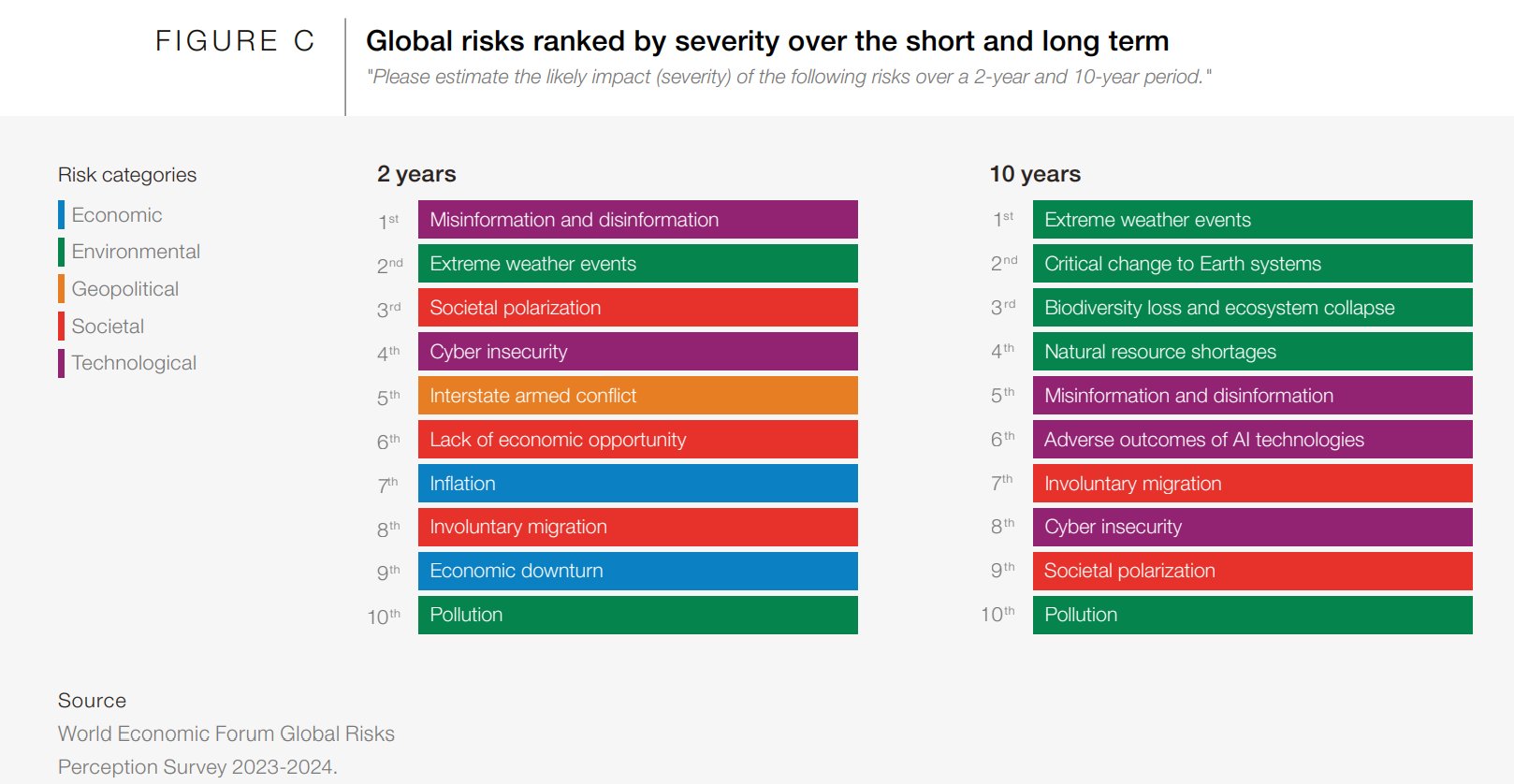
WEF’s No. 1 global risk for the next 2 years is “Misinformation and Disinformation”. Who’ll be telling the fibs and skewing the stories? At least 64 countries representing half the population of the world (including the EU, UK, USA, Taiwan) will be holding national elections and the telling of porkies will be widespread. F’rinstance, come November in the USA, the Oval Office most likely will NOT have an incumbent that is associated with pouring oil on troubled global waters – mind you, that’s an inappropriate figurative expression as we shouldn’t pour or pump oil on anything given the WEF’s No. 2 and No. 5 big 2 year business risks, viz. “Extreme Weather Events” and “Interstate Armed Conflict”. Last year has been confirmed as the hottest on record. Right now the threat of Houthi missiles are blocking the Suez Canal and drought is severely limiting the number of container ships through the Panama Canal with the result that freight rates have spiked and journey times lengthened which is dispiriting news for food traders and food consumers. “Societal Polarisation” and “Cyber Insecurity” are the 3rd and 4th shorter term business risks with the former responsible for defining food products for the well-heeled “Income Haves” and the disgruntled “Income Have Nots”.
Our attention has quickly moved on to WEF’s biggest business risks over the next 10 years. The top 4 relate to global warming: “Extreme Weather Events”; “Critical Change to Earth Systems”; “Biodiversity Loss and Ecosystem Collapse”; and “Natural Resource Shortages”. Not before time, at the UN COP28 climate talks in Dubai, 130 countries signed up to a pledge that our world should shift to “a more sustainable production and consumption of food”. I should coco! Food contributes one-third of the warming gases increasing global temperatures. Globally, consumers have worked out that what they put in their tummies has an impact on their health and on the health of the planet. Fine and dandy, but like government and the agri-food industry, they’re struggling to convert acknowledgement into action. But, action must come and come quickly. For sure, within the global food industry, businesses from farm to food consumer must “Go Green or Go Broke”! Now, there’s a happy few words to finish on a New Year missive from the 2 of us! There are scary winds ahead, but keep in mind the wise words of the American motivational speaker William Arthur Ward: “the pessimist complains about the wind; the optimist expects it to change; the realist adjusts the sails (of his/her business and career).
David Hughes and Miguel Flavian
January 10th, 2024
p.s. David gave a brief talk at the Oxford Farming Conference (Jan 5th). If interested in a copy, drop him a line on profdavidhughes@aol.com
 Supermarkets in your pocket.